
Your doctor writes a prescription for atorvastatin 10 mg and tells you to come back in six weeks for a blood test. You leave the office and immediately search whether 10 mg is a lot or a little, and whether you should be worried about muscle pain at that amount.
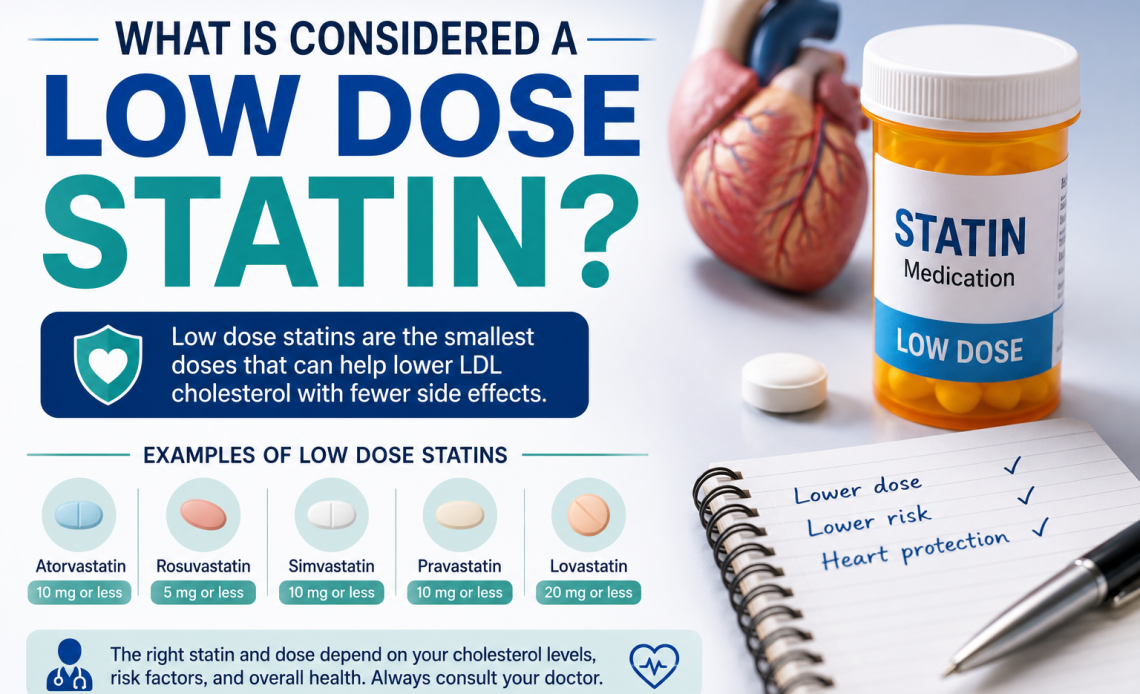
Understanding what is considered a low dose statin is more useful th-+an it might seem. The answer is not just a number. It depends on which statin you have been prescribed, because 10 mg means different things for different drugs. Clinically, the term low intensity or low dose refers to whether the statin reduces LDL cholesterol by less than 30 percent, and only certain milligram values for each drug meet that threshold.
This guide gives you the exact numbers by drug name, explains when a low dose is the right clinical choice versus a limitation, and walks through what to expect if your doctor decides to start you at the lowest tier.
What Is a Low Dose Statin
Statins are classified by their potency using a three tier intensity system developed by the American College of Cardiology (ACC) and the American Heart Association (AHA). The system groups every statin and every dose into low intensity, moderate intensity, or high intensity based on one outcome: how much they reduce LDL cholesterol.
Low intensity statins, by this definition, are doses expected to lower LDL by less than 30 percent. Moderate intensity doses reduce LDL by 30 to 49 percent. High intensity doses, which typically means high-dose rosuvastatin or atorvastatin, reduce LDL by 50 percent or more. The specific dose of the same drug can fall into a completely different intensity category. For example, simvastatin 10 mg is low intensity, but simvastatin 20 to 40 mg is moderate intensity.
Why It Matters
The classification matters for two reasons. First, the higher the dose, the stronger the LDL-lowering effect but also the greater the risk of side effects, particularly muscle pain. Approximately 15 to 20 percent of patients report muscle-related symptoms in real-world practice, and that risk is directly dose dependent. Second, not every patient needs the strongest possible dose. Someone managing mild primary prevention risk with no prior cardiovascular events often gets the same long term protection from a low or moderate intensity statin as they would from pushing to the highest dose with a higher side effect burden.
Who Typically Starts on a Low Dose Statin
- Adults starting statin therapy for the first time, where the prescriber wants to assess tolerability before escalating
- Older adults, particularly those over 75, who are more sensitive to statin side effects
- Patients of East Asian ancestry, who metabolise some statins differently and are more likely to experience side effects at standard doses
- People with chronic kidney disease or mild liver enzyme elevation where a conservative starting point reduces organ risk
- Anyone who has previously stopped a statin due to muscle pain and is restarting at a lower dose to rebuild tolerance
- Lower-risk primary prevention patients where a modest LDL reduction achieves the target without needing higher intensity
Low Dose Statin by Drug: The Exact Milligram Breakdown
| Statin (Brand Name) | Low Dose (mg/day) | Expected LDL Reduction | Intensity Tier |
| Rosuvastatin (Crestor, Ezallor) | 5 mg or less (2.5 mg in sensitive patients) | Less than 30% | Low intensity |
| Atorvastatin (Lipitor, Atorvaliq) | 10 mg | 30 to 39% (lower end of moderate for many patients) | Low to low-moderate |
| Simvastatin (Zocor, FloLipid) | 10 mg | Less than 30% | Low intensity |
| Lovastatin (Mevacor, Altoprev) | 20 mg | Less than 30% | Low intensity |
| Pravastatin (Pravachol) | 10 to 20 mg | Less than 30% | Low intensity |
| Fluvastatin (Lescol, Lescol XL) | 20 to 40 mg | Less than 30% | Low intensity |
| Pitavastatin (Livalo, Zypitamag) | 1 mg | Less than 30% | Low intensity |
Note: atorvastatin 10 mg sits at the border. For some patients it produces just under 30 percent reduction, for others it crosses into moderate intensity range. This is why some clinical sources list it as low intensity and others as low moderate. Your actual LDL response is confirmed at the six to eight week follow up blood test.
How Low Dose Statins Work
- Statins block HMG-CoA reductase, the liver enzyme that produces cholesterol. Blocking this enzyme prompts the liver to pull more LDL out of the bloodstream to compensate.
- At low doses the block is partial. Enough LDL is cleared to produce a meaningful reduction, but the effect is less than what moderate or high doses achieve.
- The relationship between dose and LDL reduction follows what is called the rule of sixes: doubling a statin dose reduces LDL by only an additional 6 percent. This is why moving from a low dose to a moderate dose produces a significant jump, but doubling a moderate dose adds only a small extra gain.
- Low doses begin lowering LDL within one to two weeks of starting, and most of the effect is visible at the four to six week mark. This is why doctors schedule a repeat lipid panel about six weeks in.
- A USPSTF systematic review covering 19 randomised controlled trials with more than 71,000 participants found that even low to moderate intensity statin doses significantly reduced heart attack risk by 36 percent and stroke risk meaningfully in primary prevention settings.
A Real Clinical Example
A 58 year old woman with no prior heart disease and an LDL of 148 mg/dL comes in for a routine physical. Her 10 year cardiovascular risk score falls in the lower primary prevention range. Her doctor starts her on rosuvastatin 5 mg, a textbook low dose. Six weeks later her LDL sits at 106 mg/dL, a 28 percent reduction, which is within low intensity territory and right at her individual target. She reports no muscle pain and the dose never needs to be escalated. This scenario plays out routinely in primary prevention. The low dose was not a compromise. It was the appropriate and sufficient intervention for her risk level. Pushing to 20 mg would have brought no additional meaningful cardiovascular benefit while adding side effect exposure she did not need.
Common Mistakes and Myths About Low Dose Statins
- Assuming low dose means ineffective. For patients who only need a modest LDL reduction to hit their target, a low dose achieves the goal with less side effect risk. It is not a weak option. It is the right-sized option for that patient.
- Thinking 10 mg is always low intensity regardless of the drug. Rosuvastatin 10 mg is actually moderate intensity and lowers LDL by roughly 38 to 45 percent. Atorvastatin 10 mg is near the low to moderate boundary. The same milligram number means very different things across drugs.
- Stopping a low dose because it did not hit the LDL target. The right response when a low dose is insufficient is escalation or adding ezetimibe (Zetia), not stopping the statin entirely. Even subtherapeutic LDL lowering confers some cardiovascular benefit.
- Blaming every symptom on the statin. A well-documented nocebo effect means patients who have read about statin muscle pain are significantly more likely to report it even when taking a placebo. Studies show that roughly 30 percent of people stop statins due to muscle pain even on dummy pills. If muscle pain appears, it is worth confirming with a rechallenge at the same dose rather than assuming the statin is the cause.
- Believing a low dose statin cannot be used long term. For patients at lower risk who hit their LDL goal on a low dose, there is no clinical reason to escalate. Long term use at a low dose is entirely appropriate and is often the plan.
The clinical observation most patients never hear: muscle pain from statins is dose-dependent, not just statin-dependent. Many people who could not tolerate 40 mg of simvastatin do fine on 10 mg, or switch to hydrophilic statins like pravastatin or rosuvastatin which are less likely to penetrate muscle tissue.
Low vs Moderate vs High Intensity Statins: When Each Is Used
| Intensity | LDL Reduction | Typical Doses | Best Used For |
| Low intensity | Less than 30% | Rosuvastatin 5 mg, pravastatin 10 to 20 mg, simvastatin 10 mg, lovastatin 20 mg | Lower-risk primary prevention, tolerance building after side effects, sensitive patient populations |
| Moderate intensity | 30 to 49% | Rosuvastatin 10 mg, atorvastatin 10 to 20 mg, simvastatin 20 to 40 mg, pravastatin 40 to 80 mg | Intermediate cardiovascular risk, primary prevention for most adults, patients with diabetes or hypertension |
| High intensity | 50% or more | Rosuvastatin 20 to 40 mg, atorvastatin 40 to 80 mg | High and very high cardiovascular risk, established heart disease, prior heart attack or stroke, LDL above 190 mg/dL |
Practical Steps If You Are Starting a Low Dose Statin
- Take it consistently at the same time each evening. Most statins work best taken at night when the liver ramps up cholesterol production, though rosuvastatin and atorvastatin can be taken any time of day.
- Avoid grapefruit and grapefruit juice if you are taking atorvastatin, simvastatin, or lovastatin. Grapefruit slows the metabolism of these statins and causes the blood level to rise, increasing both effect and side effect risk.
- Schedule your follow up lipid panel at 6 to 8 weeks, not 6 months. This is when the low dose has had enough time to show its LDL-lowering effect and when your doctor can decide whether to escalate.
- If you experience muscle aches, note when they started relative to when you began the statin. Pain that begins in the first few weeks and affects large muscle groups symmetrically (both thighs, both shoulders) is more likely to be statin-related than pain that develops months later or affects only one side.
- Tell your doctor about all other medications, including over the counter supplements. Several drugs including gemfibrozil, some antifungals, and certain antibiotics raise statin blood levels and can turn a safe low dose into an effective high dose inside the body.
- If you switched from a higher dose due to side effects, give the lower dose at least 4 to 6 weeks before concluding it is also causing the same problem. Some symptoms take time to resolve after a dose reduction.
Questions People Often Have About Low Dose Statins
What is the lowest dose statin available?
Rosuvastatin is available in a 5 mg dose, and in some cases clinicians start sensitive patients at 2.5 mg (a half tablet) or even less. Pitavastatin 1 mg is another very low starting option. These ultra-low starting points are typically reserved for East Asian patients, those with kidney disease, or people who have had severe side effects at even low standard doses.
Is a low dose statin actually worth taking?
Yes. A USPSTF review of over 71,000 participants across 19 trials showed that even low to moderate intensity statins reduced heart attack risk by 36 percent in primary prevention. The absolute benefit depends on your baseline cardiovascular risk, but for eligible patients the evidence for low dose use is solid.
Can I switch from a high dose to a low dose statin on my own?
No. Reducing your statin dose without medical guidance can leave your LDL uncontrolled and raise cardiovascular risk without you knowing it. If you are concerned about side effects or want to try a lower dose, speak with your prescriber first. They will recheck your LDL after the change.
Why would a doctor keep me on a low dose instead of increasing it?
If a low dose achieves your LDL target, escalation adds side effect risk without adding meaningful benefit. Many patients at lower cardiovascular risk hit their number on 5 to 10 mg and have no reason to move higher. The goal is the LDL level, not the dose size.
Do low dose statins still cause muscle pain?
They can, but the risk is lower than at higher doses. Muscle pain is the most dose-dependent of all statin side effects. Some patients who cannot tolerate 40 mg can manage 10 mg without any symptoms. Switching to a more hydrophilic statin like pravastatin or rosuvastatin at a low dose further reduces muscle penetration and the associated risk.
How long do I need to take a low dose statin?
For most patients, statin therapy is lifelong. Stopping treatment causes LDL to return to its previous level within weeks, which removes the cardiovascular protection that comes from long-term lower LDL exposure. Some patients in very low risk categories may discuss deprescribing with their doctor, but this is a shared decision based on individual risk reassessment.
Expert Insight
One pattern that shows up clearly in clinical practice: patients who are started on a low dose and told it might be increased later often interpret that framing as the low dose being inferior or inadequate. It is not. The conservative start is deliberate. The follow up blood test at six weeks is the checkpoint. If the LDL target is hit, the dose stays where it is. If not, it moves up or ezetimibe is added. The dose is the tool, not the measure of how seriously the prescriber is treating your cholesterol.
A systematic review cited by the US Preventive Services Task Force found that low to moderate intensity statins significantly reduced heart attack risk by 36 percent and produced meaningful stroke reduction in primary prevention patients, confirming that low intensity does not mean low benefit for the right patient.
The Dose Is Not the Treatment: A Framework for Thinking About Statin Intensity
A useful reframe: your prescriber is not choosing between weak and strong treatment. They are choosing between achieving a target LDL with the minimum effective dose versus pushing higher. Three questions drive the decision:
- What is your LDL target? This is driven by your 10-year cardiovascular risk score, not by a one-size-fits-all number.
- Which dose reaches that target? The follow up lipid panel answers this. If a 5 mg rosuvastatin brings LDL from 145 to 98 mg/dL, nothing more is needed.
- What can you tolerate long term? A low dose statin taken every day for 20 years outperforms a high dose statin abandoned after 6 months due to muscle pain. Tolerance matters more than intensity for long-term outcome.
Contrarian but defensible take
The rule of sixes undermines the case for always pushing to the highest dose. Doubling a statin dose adds only about 6 percent more LDL reduction. Going from rosuvastatin 5 mg to 20 mg quadruples the dose but adds roughly 12 to 18 percent more LDL lowering while meaningfully increasing side effect risk. For most primary prevention patients, the risk-reward math favours staying at the lowest effective dose, not chasing the maximum.
Linking Strategy
Internal links from capitalhealthhopewell.com
- High cholesterol often overlaps with related lipid disorders. Read our detailed explanation of mixed hyperlipidemia meaning: what it is, why it matters, and how to manage it to understand how combined cholesterol and triglyceride elevation changes the treatment picture.
- Chest discomfort can be an early sign that lipid-related arterial damage has progressed. See our guide on heart palpitations after eating: causes, triggers, and when to see a doctor for cardiovascular symptoms worth knowing.
- Diet plays a direct role in LDL and triglyceride levels alongside medication. Explore is garlic powder good for you: benefits, nutrition, and how to use it for a practical heart-healthy dietary addition.
External authoritative sources
- American Heart Association statin safety statement: heart.org
- Cleveland Clinic on managing statin muscle pain: clevelandclinic.org
Technical and On Page SEO Checklist
- H1 contains the primary keyword once: What Is Considered a Low Dose Statin
- Keyword appears in the second paragraph of the introduction, bolded
- H2 and H3 headings mirror subtopics and natural-language FAQ questions
- Word count target: 1,900 to 2,400 words, match the top 3 ranking competitors at plus or minus 20 percent
- Include a visual dose comparison chart or table as an image with descriptive alt text such as: table showing low moderate and high intensity statin doses and their LDL reduction percentages
- Short paragraphs throughout, 2 to 3 lines maximum before a line break
- Mobile rendering check on the drug dosage table and intensity comparison table before publishing
- Add FAQPage schema markup to the Questions People Often Have section
- Add Article schema to the full piece with datePublished, author, and publisher fields
- Add a medical disclaimer note below the article title or in the footer confirming the content is for informational purposes only
Conclusion: What to Do Next
What to do next
If you have just been prescribed a statin, confirm with your prescriber which intensity tier your dose falls into and what LDL target they are aiming for. Ask specifically whether the current dose is expected to reach that target or whether it is a starting point with a review built in.
Act on the follow up test
The 6 to 8 week lipid panel is the most important appointment in the first round of statin therapy. It tells you and your doctor whether the low dose is doing the job or whether a dose adjustment or a second agent like ezetimibe is needed.
When to wait
If you are only mildly concerned about muscle discomfort, give the low dose 4 to 6 weeks before deciding it is causing symptoms. Many early aches that patients attribute to their statin resolve on their own as the body adjusts.
What to avoid
Do not compare your dose to someone else’s. A friend taking rosuvastatin 20 mg is not on a stronger or more serious treatment plan than you. They have a different risk profile and a different LDL target. The dose that is right for them may be more than you need, and taking more statin than necessary adds side effect risk with no additional cardiovascular benefit for your individual situation.