
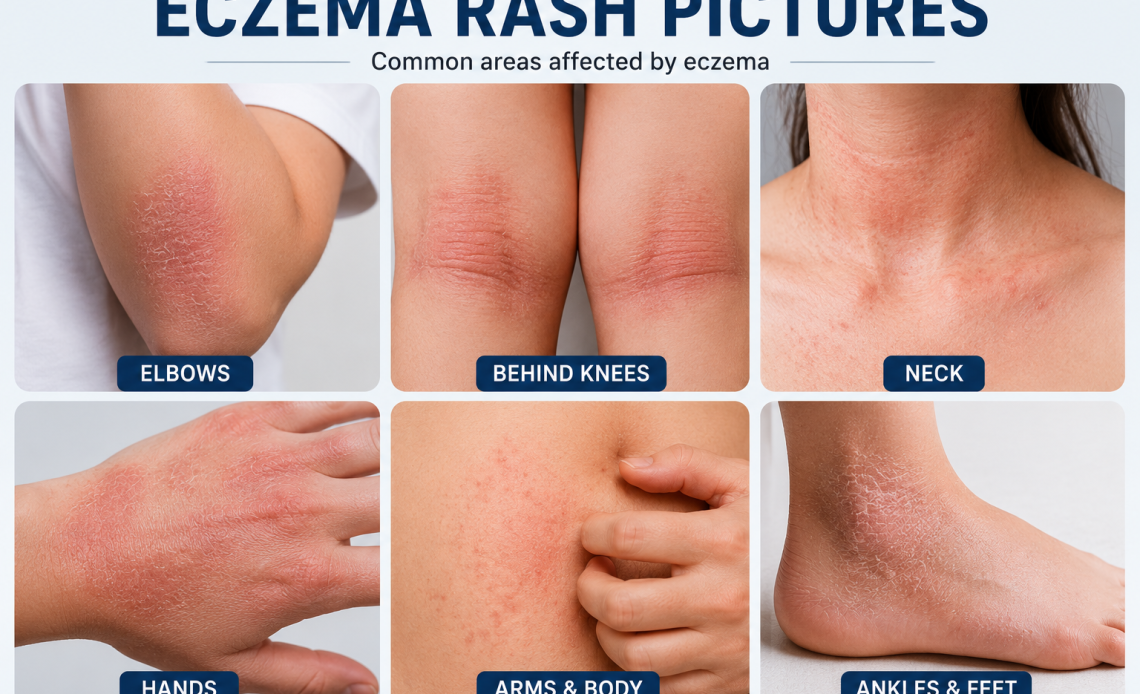
How to read common visual clues without relying on a photo for diagnosis
Searching eczema rash pictures can help you recognize patterns such as dry scaling, intense itching, rough bumps, oozing, crusting, or thickened skin. However, eczema does not have one universal appearance. It can look pink or red on lighter skin and dark brown, purple, gray, or ashy on darker skin. Its appearance also changes with age, body location, scratching, infection, and the stage of a flare.
A picture can provide clues, but it cannot confirm the diagnosis. Heat rash, psoriasis, ringworm, contact dermatitis, hives, and some skin infections can resemble eczema. The most useful approach is to compare color, texture, border, itch, location, timing, and triggers rather than matching one online photo.
Key Takeaways
| • Eczema usually causes intense itching with dry, rough, scaly, cracked, or inflamed skin.
• Active eczema may ooze or crust, while long-standing eczema can become thick and leathery from repeated scratching. • On darker skin tones, inflammation may look purple, gray, dark brown, or only slightly different from surrounding skin. • Heat rash is more closely linked to sweating and often forms clusters of tiny bumps or blisters without the persistent dry scale typical of eczema. • Rapid spreading, pain, fever, pus, honey-colored crusts, eye involvement, or widespread blistering needs prompt medical evaluation. |
How Should You Read an Eczema Photo?
Start by looking beyond color. Color changes can be subtle and vary with skin tone, lighting, camera quality, and whether the rash is new or healing. Texture and symptoms often provide better clues. Eczema commonly feels rough, dry, scaly, warm, swollen, or cracked. It also tends to itch strongly, sometimes before the rash becomes obvious.
| Visual Clue | What It May Suggest | Important Limitation |
| Dry scale and cracking | A damaged skin barrier, often seen with eczema | Psoriasis and fungal rashes can also scale |
| Tiny rough bumps | Common presentation in children and darker skin tones | Heat rash and follicular conditions may look similar |
| Oozing or crusting | An active eczema flare or infection | Color and drainage should be assessed by a clinician |
| Thick, leathery skin | Long-term rubbing or scratching | Other chronic itchy conditions can also thicken skin |
| Sharp ring-shaped border | Ringworm is more likely than typical eczema | Nummular eczema can still look circular |
| Clusters after sweating | Heat rash becomes more likely | Heat can also trigger an eczema flare |
The American Academy of Dermatology overview of atopic dermatitis symptoms describes dry, scaly areas, rough bumps, scratch marks, leaking fluid, oozing blisters, crusting, and skin that may become lighter or darker after healing. These features can appear in different combinations rather than all at once.
What Does Eczema Look Like at Different Flare Stages?
What Does an Early Flare Look Like?
An early flare may begin with itching, warmth, mild swelling, or a patch that feels rough before the color change is obvious. On lighter skin, the area may become pink or red. On deeper skin tones, it may look purple, gray, dark brown, or ashy. Small bumps may appear, especially in children.
What Does an Active or Weeping Flare Look Like?
More active eczema can look swollen, raw, intensely inflamed, and scratched. Small blisters may leak clear fluid and form crusts. This stage can resemble contact dermatitis or infection. Yellow drainage, pus, rapidly increasing pain, fever, or expanding warmth should not be assumed to be normal eczema.
What Does Chronic Eczema Look Like?
When an area is rubbed or scratched repeatedly, the skin may become thick, deeply lined, darker, rough, and leathery. This change is called lichenification. Chronic patches may itch almost constantly and can crack during dry weather or frequent washing.
What Does Healing Eczema Look Like?
As inflammation settles, scale, swelling, and oozing usually decrease. The skin may remain lighter or darker than the surrounding area for weeks or months. A color mark after healing does not always mean the eczema is still active, but persistent itch, new bumps, or worsening scale may signal another flare.
How Does Eczema Look on Different Skin Tones?
Online image results often overrepresent redness on light skin. On medium and dark skin tones, eczema may appear violet, gray, dark brown, or ashen. Small rough bumps can be more noticeable than redness. Inflammation may also leave pronounced dark or light marks after the flare.
Because redness can be difficult to see, pay attention to warmth, swelling, texture, itching, scratching, sleep disruption, and changes from the person’s normal skin. Medical evaluation is especially useful when color alone does not clearly show whether inflammation is active.
What Does Eczema Look Like on Different Body Areas?
| Body Area | Common Eczema Appearance | Common Lookalike |
| Face and eyelids | Dry, itchy, poorly defined patches with swelling or flaking | Contact dermatitis, seborrheic dermatitis |
| Elbow and knee creases | Itchy, scaly patches that may thicken with scratching | Heat rash in sweaty folds |
| Hands | Cracking, dryness, burning, blisters, or oozing between fingers | Irritant or allergic contact dermatitis |
| Palms and soles | Deep, intensely itchy small blisters in dyshidrotic eczema | Fungal infection or hand-foot rash |
| Legs | Dry itchy patches, coin-shaped spots, or thickened skin | Psoriasis, ringworm, stasis dermatitis |
| Scalp and hairline | Flaking and itch, sometimes greasy or yellowish | Scalp psoriasis or dandruff |
For lower-body rashes, the guide to a red rash on the legs explains how eczema and contact dermatitis can differ from cellulitis, psoriasis, stasis dermatitis, and other causes that may need faster medical attention.
How Can You Tell Heat Rash From Eczema in Pictures?
| Feature | Eczema | Heat Rash |
| Main trigger | Dryness, irritants, allergens, immune activity, friction, or other personal triggers | Blocked sweat ducts during hot, humid, or sweaty conditions |
| Texture | Dry, rough, scaly, cracked, or thickened | Clusters of tiny bumps or small blisters, often without scale |
| Sensation | Usually intense itch; may burn or feel sore | Prickly, itchy, or burning sensation |
| Typical areas | Face, hands, neck, wrists, elbows, knees, ankles, or almost anywhere | Neck, upper chest, groin, under breasts, and skin folds |
| Course | Often chronic with repeated flares | Often improves after cooling and keeping skin dry |
The CDC heat rash guidance describes heat rash as clusters of pimples or small blisters caused by excessive sweating in hot, humid conditions. Moving to a cooler environment and keeping the area dry are central first steps. Avoid assuming every summer rash is heat rash, because sweating can also aggravate eczema.
Which Conditions Commonly Look Like Eczema?
- Psoriasis often produces thicker, more sharply bordered plaques with visible scale. Eczema usually has less distinct edges and often causes stronger itching, cracking, oozing, or crusting.
- Contact dermatitis often follows a clear exposure pattern, such as a new soap, detergent, fragrance, glove, metal, adhesive, plant, or cosmetic. The shape may match the area of contact.
- Ringworm often forms a circular or expanding patch with a more active scaly edge and relative clearing toward the center. Steroid cream can temporarily change its appearance and make diagnosis harder.
- Hives usually create raised, smooth welts that move, fade, or change shape within hours. Eczema patches tend to remain in the same place for longer and feel rough or dry.
- Skin infection may cause increasing pain, warmth, swelling, pus, spreading redness or discoloration, honey-colored crusts, fever, or red streaks.
A side-by-side review of pictures of eczema and psoriasis can help readers compare border sharpness, scale thickness, body location, oozing, and nail changes. A dermatologist may still need to examine or test the skin when the pattern is unclear.
How Can You Take Better Rash Photos for a Doctor?
Clear photos can help document change over time and support a telehealth visit, but they should not delay urgent care. Use the same lighting and distance when possible.
- Take one wider photo that shows the body location and one close-up that shows texture.
- Use bright natural light without filters, beauty mode, or flash glare.
- Place a ruler or coin nearby for size, without touching broken skin.
- Photograph the rash before applying tinted creams or makeup.
- Record when it started, how quickly it spread, how much it itches or hurts, and what products touched the area.
- Include a photo of both sides when only one side is affected, so the clinician can compare.
What Can You Do While Waiting for a Diagnosis?
For a mild, familiar eczema flare, use fragrance-free moisturizer, take short lukewarm showers, wear soft breathable clothing, and avoid scratching, heat, and known irritants. Follow an existing treatment plan from your clinician if you have one. Do not start a strong steroid, antifungal, antibiotic, or bleaching product solely because a picture online appears similar.
If the rash followed a new product, stop that product and note its ingredients. If heat and sweat appear to be the main trigger, move to a cooler setting and keep the area dry. New rashes in infants, pregnant people, immunocompromised patients, or people taking a new medicine deserve a lower threshold for medical review.
When Should an Eczema-Like Rash Be Checked Urgently?
- Rapid spreading, significant pain, warmth, swelling, or fever
- Pus, honey-colored crusts, foul odor, or red streaks
- Clusters of painful blisters, especially near the eyes or across a large area
- Facial swelling, trouble breathing, dizziness, or widespread hives
- A rash with purple spots that do not fade when pressed
- Skin peeling, mouth sores, eye irritation, or a rash after starting a new medication
- Persistent symptoms that do not improve with basic skin care or keep returning
Frequently Asked Questions
Can eczema look like small bumps instead of a red patch?
Yes. Small rough or itchy bumps are common, especially in children and on darker skin tones. Scratching may cause the bumps to ooze and crust.
Can eczema form blisters?
Yes. Dyshidrotic eczema can cause clusters of deep itchy blisters on the palms, fingers, and soles. Other eczema flares may also weep or form small blisters.
Does eczema always itch?
Itching is one of the strongest clues and may begin before the visible rash. Burning, soreness, and sleep disruption can also occur.
Can eczema be circular like ringworm?
Nummular eczema forms coin-shaped patches and can resemble ringworm. Ringworm often has a more active raised edge, but examination or testing may be needed.
Why does eczema look darker after it heals?
Inflammation can temporarily increase or decrease pigment. These marks may last longer than the active itch and scale, especially on deeper skin tones.
Can you diagnose eczema from a photo?
A photo can suggest possibilities, but it cannot reliably rule out infection, psoriasis, ringworm, contact dermatitis, or medication reactions. Clinical history and examination matter.
The Bottom Line
Eczema rash pictures are most useful when they teach you which details to notice, not when they encourage self-diagnosis. Eczema commonly combines strong itching with dryness, roughness, scale, cracking, oozing, crusting, or thickened skin. The color may be red, pink, purple, gray, dark brown, or ashy depending on skin tone and flare stage.
Compare the texture, border, location, timing, triggers, and symptoms. When a rash is painful, rapidly spreading, infected-looking, blistering, or linked to fever or a new medication, seek professional care rather than relying on an online photo match.
Medical disclaimer: This article is for general education and does not diagnose a skin condition or replace care from a qualified healthcare professional.