
| Jump To |
| Eczema, Explained |
| Psoriasis, Explained |
| Visual Differences by Body Location |
| Key Differences at a Glance |
| Takeaways |
| FAQs |
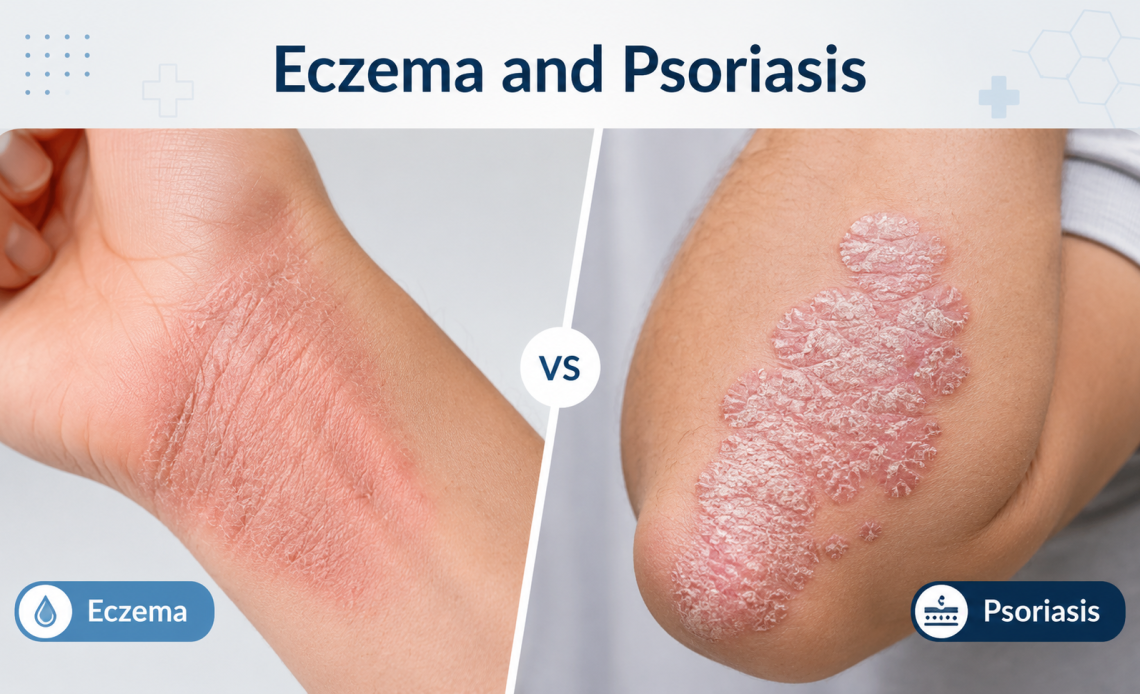
Approximately 39 million people in the United States have either eczema or psoriasis, according to the National Psoriasis Foundation and the National Eczema Association. Both conditions cause red, inflamed, uncomfortable patches of skin — which means they are frequently confused with each other. Looking at pictures of eczema and psoriasis side by side is one of the most useful tools for understanding how these conditions differ, because the visual cues — texture, border definition, scale colour, and location — tell a clear story once you know what to look for.
This guide breaks down what each condition looks like in different areas of the body, explains the visual and clinical differences a dermatologist would use to distinguish them, and provides a location-by-location comparison across the face, scalp, hands, legs, and skin folds.
If you are experiencing chronic skin symptoms and are not sure whether you have eczema, psoriasis, or another condition, the dermatology team at Capital Health Hopewell can provide an accurate diagnosis and personalised treatment plan.
ECZEMA, EXPLAINED
What Is Eczema?
Eczema — most commonly referring to atopic dermatitis — is a chronic inflammatory skin condition that causes dry, itchy, inflamed patches of skin. It affects people of all ages, though it is especially prevalent in children. According to the National Eczema Association, one of eczema’s most defining characteristics is its itch — often described as relentless and present before any visible rash appears. This is why eczema is sometimes called ‘the itch that rashes’: the scratching comes first, and the rash follows in the scratched area.
Eczema tends to appear in skin folds — the creases of the elbows, behind the knees, on the wrists, and around the neck — though it can develop anywhere on the body. The National Psoriasis Foundation notes that eczema generally causes more intense itching than psoriasis, and in more severe cases the skin may weep, ooze, or crust over. Over time, repeated inflammation can cause the skin to thicken — a process called lichenification.
Types of Eczema
- Atopic dermatitis. The most common and well-known form — chronic, often linked to a personal or family history of allergies or asthma. Causes red, scaly, intensely itchy patches that frequently affect skin folds.
- Contact dermatitis. Triggered by direct contact with an irritant or allergen — such as a new soap, detergent, jewellery, or skin-care ingredient. Causes localised redness, itching, and sometimes blistering in the area of exposure.
- Dyshidrotic eczema. Characterised by clusters of small, intensely itchy blisters on the palms, fingers, and soles of the feet. Often associated with stress, seasonal allergies, or contact with metals such as nickel.
- Nummular eczema. Presents as round, coin-shaped patches of dry, scaly, itchy skin — typically on the arms, legs, or torso. The circular shape can resemble ringworm, though the causes and treatment differ.
- Seborrhoeic dermatitis. Causes oily, flaky patches with a yellowish tinge, predominantly on the scalp, face, and upper chest. Related to an overreaction to yeast naturally present on the skin.
- Flexural eczema. A form of atopic dermatitis that specifically targets skin fold areas — inside the elbows, behind the knees, armpits, and groin. Skin appears red, inflamed, and may be moist.
- Stasis dermatitis. Affects the lower legs in people with poor venous circulation. Causes redness, swelling, and skin irritation — often associated with varicose veins or oedema.
PSORIASIS, EXPLAINED
What Is Psoriasis?
Psoriasis is a chronic autoimmune condition in which the immune system sends faulty signals that accelerate the skin cell production cycle. According to the American Academy of Dermatology, a healthy skin cell matures and sheds in about 30 days; in psoriasis, this cycle is compressed to 3–4 days. The result is a rapid accumulation of skin cells on the surface, forming the thick, scaly plaques that characterise the condition.
Psoriasis plaques are well-defined — meaning their edges are sharply bordered and easy to distinguish from the surrounding skin. They are typically raised, with a red or dark inflamed base and a covering of silver-white scales. Unlike eczema, psoriasis does not usually weep or ooze. Both conditions can cause itching, but psoriasis is more likely to also produce burning or stinging sensations.
Types of Psoriasis
- Plaque psoriasis. The most common type — accounts for around 80–90% of cases. Causes raised, inflamed patches covered in thick, silvery-white scales. Most commonly found on the elbows, knees, lower back, and scalp.
- Guttate psoriasis. Characterised by small, drop-shaped red or pink spots scattered across the torso, arms, and legs. Often triggered by a streptococcal throat infection and is more common in children and young adults.
- Inverse psoriasis. Affects skin folds — the armpits, under the breasts, groin, and buttocks. Unlike plaque psoriasis, it causes smooth, shiny lesions without the typical scaling, because the moist environment prevents scale build-up.
- Scalp psoriasis. Produces thick, adherent scales on the scalp that can extend beyond the hairline onto the forehead and back of the neck. Stinging and burning are common alongside itching.
- Pustular psoriasis. A less common form that produces white, pus-filled blisters surrounded by inflamed skin — typically on the palms or soles, though it can be widespread.
- Erythrodermic psoriasis. A rare, severe form that causes widespread redness and peeling over most of the body’s surface. Can be life-threatening and requires emergency medical treatment.
- Nail psoriasis. Affects fingernails and toenails, causing pitting, thickening, discolouration, and in some cases separation of the nail from the nail bed (onycholysis).
Both eczema and psoriasis are conditions that benefit significantly from professional dermatological care and ongoing management. For expert evaluation and treatment in the Hopewell area, visit Capital Health Hopewell.
VISUAL DIFFERENCES
Eczema vs. Psoriasis: Visual Differences by Body Location
While the overall characteristics of each condition provide a useful framework, appearance can vary considerably depending on where the skin is affected. Here is a location-by-location breakdown of how eczema and psoriasis typically look — and what sets them apart in each area.
On the Face
Eczema on the face tends to appear as dry, red, itchy patches — most commonly around the eyelids, cheeks, lips, and the skin around the mouth. The borders of the affected areas are generally less defined, and the skin may weep or crust in more severe cases. Facial eczema is far more common than facial psoriasis.
Psoriasis on the face most commonly affects the eyebrows, forehead, and the area around the hairline. The patches are typically more sharply defined, with the characteristic silvery-white scale. Psoriasis rarely affects the central face the way eczema can.
On the Scalp
Scalp eczema (seborrhoeic dermatitis) often resembles dandruff — producing flaky, itchy skin that may appear greasy or yellowish. The itch tends to be more intense than with scalp psoriasis.
Scalp psoriasis produces thicker, more firmly attached scales that are silvery-white rather than yellowish. These scales frequently extend beyond the hairline onto the forehead, the back of the neck, and the skin around the ears — a pattern less typical of eczema. Stinging and burning alongside itching are more characteristic of scalp psoriasis.
On the Hands
Both conditions can cause significant discomfort on the hands, but they look different on close inspection. Eczema on the hands tends to produce dry, cracked, itchy skin that may weep or ooze — particularly between the fingers and on the palms. It is often associated with environmental exposures: frequent handwashing, contact with cleaning products, chemicals, or latex.
Psoriasis on the hands produces thicker, more sharply defined scaly plaques, usually on the backs of the hands, palms, and fingertips. Nail involvement — pitting, thickening, and discolouration — is a strong indicator of psoriasis rather than eczema, as nail changes are uncommon in atopic dermatitis.
On the Legs
Eczema on the legs typically affects the skin behind the knees — a classic flexural location — and may cause chronic scratching that leads over time to lichenification: thick, leathery, rough-textured skin. The borders of eczema patches on the legs tend to be indistinct, blending gradually into surrounding skin.
Psoriasis on the legs is most commonly found on the front of the knees — the outer surface rather than the crease. The patches are well-demarcated with raised, thick plaques and silvery scales. On darker skin tones, the inflamed base of psoriasis plaques may appear purple or dark brown rather than red.
In Skin Folds — Armpits, Under Breasts, and Groin
Eczema in skin folds (flexural eczema) causes red, itchy, inflamed patches that may be moist. In the armpits and groin, it is often associated with a specific irritant — a new antiperspirant, a detergent, clothing fabric, or a personal care product. The skin may weep and become secondarily infected if scratching is prolonged.
Inverse psoriasis in these areas looks notably different from plaque psoriasis. Because skin folds are warm, moist, and subject to friction, the thick dry scaling typical of plaque psoriasis does not develop. Instead, inverse psoriasis causes smooth, shiny, well-defined lesions that are red or pink on lighter skin and dark brown or purple on deeper skin tones. The absence of scaling is a key distinguishing feature from both plaque psoriasis and flexural eczema.
On Black and Brown Skin Tones
Both eczema and psoriasis look different on darker skin tones — and this difference is clinically important because many descriptions and images of these conditions are based predominantly on lighter skin. Research published in the NIH’s StatPearls database confirms that post-inflammatory hyperpigmentation is significantly more common in people with darker skin. This means that in addition to the active inflammation, the affected areas may appear darker, ashen, or hyperpigmented — and that darkening can persist for months even after the underlying condition has been treated.
On Black skin, eczema typically appears as darker, ashen, or hyperpigmented patches rather than the red patches more visible on light skin. Psoriasis on Black or brown skin often presents as purple or dark brown plaques with grey rather than silvery scaling. Recognising these presentations is essential for accurate diagnosis in people with deeper skin tones.
KEY DIFFERENCES
Key Differences at a Glance
| Feature | Eczema | Psoriasis |
| Underlying cause | Impaired skin barrier + immune sensitivity to triggers | Autoimmune — overactive immune system accelerates skin cell turnover |
| Appearance | Red, inflamed patches; skin may weep, ooze, or crust | Thick, raised plaques with silvery-white scales; well-defined borders |
| Itch intensity | Typically severe — often described as the primary symptom | Present but generally less intense; burning and stinging also common |
| Scale colour and texture | Absent or fine/flaky; sometimes yellowish (seborrhoeic) | Thick, silvery-white, firmly adherent scales |
| Border definition | Indistinct — blends into surrounding skin | Well-defined, sharply demarcated edges |
| Typical locations | Skin folds (behind knees, inside elbows), face, wrists | Outer surfaces (knees, elbows), scalp, lower back |
| Skin fold appearance | Inflamed, itchy, may weep | Smooth, shiny, no scaling (inverse psoriasis) |
| Nail involvement | Rare | Common — pitting, thickening, discolouration |
| On darker skin | Ashen, hyperpigmented patches | Purple or dark brown plaques with grey scaling |
| Contagious? | No | No |
TAKEAWAYS
Takeaways
Eczema and psoriasis share some surface-level similarities — both cause uncomfortable, inflamed skin and can appear anywhere on the body — but they are distinct conditions with different causes, different visual presentations, and different treatments. Eczema tends to produce less sharply defined, intensely itchy patches that may weep and crust; psoriasis produces thick, scaly, well-demarcated plaques that burn and sting as much as they itch.
Location matters: eczema typically affects the inside of skin folds; psoriasis favours the outer surfaces of joints. Nail involvement strongly suggests psoriasis. On darker skin tones, both conditions may present differently than in standard medical images — with hyperpigmentation, ashen patches, and purple or brown-toned plaques that require a trained eye to recognise.
Accurate diagnosis by a board-certified dermatologist is essential before beginning any treatment. The right treatment for psoriasis will not help eczema, and vice versa. If you are unsure which condition you have, or if your symptoms are not responding to what you’re currently using, a professional evaluation is the most important next step.
For expert dermatology care and an accurate diagnosis of skin conditions including eczema and psoriasis, the team at Capital Health Hopewell is available to help you find relief and build a management plan that works for your skin.
FAQS
Frequently Asked Questions
Can you have both eczema and psoriasis at the same time?
Yes — it is possible, though not common. Because eczema and psoriasis have different underlying mechanisms — eczema involves a skin barrier defect and sensitivity to external triggers, while psoriasis is driven by an autoimmune process that accelerates skin cell production — they can theoretically co-exist. In practice, distinguishing them is challenging without a professional evaluation. If you have patches that look and behave differently from each other in different areas of your body, mention this to your dermatologist, as it may indicate more than one condition is present.
Why does post-inflammatory hyperpigmentation last longer in people with darker skin?
When eczema or psoriasis inflames the skin, it stimulates the melanocytes — the cells that produce pigment — to increase melanin production in the affected area. On darker skin tones, this response is more pronounced, and the resulting hyperpigmentation can remain visible for weeks or months after the inflammation has resolved. This means that treating the active eczema or psoriasis is only part of the management challenge for many patients with Black or brown skin — addressing the residual pigmentation change requires additional dermatological support.
What is the main visual difference between eczema and psoriasis?
The clearest visual distinction is the appearance of the skin patches themselves. Eczema tends to produce less well-defined, intensely itchy patches that may look wet, crusted, or weeping in active phases — the borders blur into surrounding skin. Psoriasis produces thick, raised plaques with sharply defined edges and a distinctive thick, silvery-white scale. If you look at pictures of eczema and psoriasis side by side, the silvery scale and sharp border of psoriasis are usually the most obvious distinguishing features, even to the untrained eye.
How does location help identify eczema vs. psoriasis?
Location is one of the most useful clinical clues. Eczema classically affects flexural areas — the inside of the elbows, behind the knees, the wrists, and the neck. Psoriasis classically affects extensor surfaces — the outer aspect of the elbows, the front of the knees, and the lower back. Scalp involvement is common in both, but psoriasis tends to extend beyond the hairline in a way eczema usually does not. In skin folds, eczema may weep and crust while inverse psoriasis produces smooth, shiny lesions without scaling. These location patterns provide strong diagnostic clues even before a biopsy or specific test.
When should I see a dermatologist for a skin rash?
You should see a dermatologist if: a rash persists beyond two to three weeks without clear improvement; it is significantly affecting your sleep, daily function, or quality of life; it is spreading or changing in character; over-the-counter treatments are not providing relief; or you are uncertain whether what you have is eczema, psoriasis, or another skin condition entirely. Both eczema and psoriasis are manageable with the right treatment, but self-diagnosis and self-treatment can delay effective care and in some cases cause harm — particularly with inappropriate steroid use. A professional diagnosis is always the most efficient path to relief.