
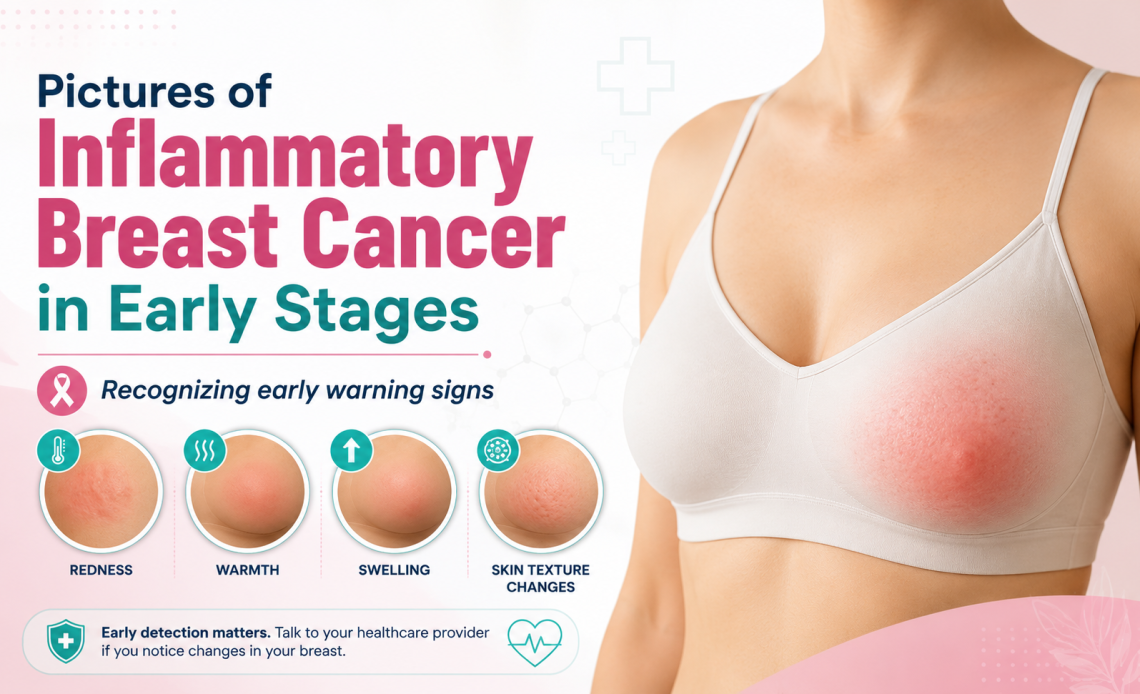
Pictures of inflammatory breast cancer in early stages are searched for often because this cancer doesn’t look or behave like most people expect breast cancer to. According to the National Cancer Institute’s overview of inflammatory breast cancer, inflammatory breast cancer (IBC) is a rare, fast-growing cancer that blocks lymph vessels in the skin of the breast, causing it to look red, swollen, and dimpled, often without any lump you can feel, which is exactly why it’s so often missed or mistaken for something else in its early stages.
| ⚠ WHY SPEED MATTERS WITH THIS ONE
IBC symptoms typically develop and worsen rapidly, often within days to a few weeks, not months. If you notice sudden breast swelling, redness, or skin changes, don’t wait to see if it resolves on its own, contact a doctor promptly. IBC is frequently misdiagnosed at first as mastitis or a skin infection, which can delay proper treatment. If antibiotics for a suspected breast infection aren’t clearly improving symptoms within a few days, ask your doctor directly about ruling out IBC. |
What Makes Early IBC Different From Typical Breast Cancer
Most breast cancers are first noticed as a distinct lump. Inflammatory breast cancer usually doesn’t form one, which is part of why it’s considered particularly dangerous. Instead, cancer cells block the tiny lymphatic vessels within the skin of the breast, causing the visible changes described below, often without anything you could feel as a discrete mass. It can also be harder to detect on a standard mammogram for this same reason.
Early Signs, Described in Detail
| Sign | What It Looks/Feels Like | Why It Happens |
| Redness (erythema) | A pink to deep red discoloration covering a large portion of the breast, often more than a third of its surface, rather than a small localized patch | Blocked lymphatic drainage causes inflammation-like skin changes |
| Peau d’orange (orange peel skin) | Small pits and dimples across the skin, giving it a texture similar to an orange peel | Fluid buildup (lymphedema) under the skin from blocked lymph vessels |
| Swelling | The affected breast may noticeably enlarge, sometimes rapidly, and may no longer fit comfortably in a normal bra | Fluid accumulation from lymphatic blockage |
| Warmth | The skin feels distinctly warm or hot to the touch compared to the other breast | Increased blood flow and inflammation-like response in the tissue |
| Thickened or ridged skin | Skin may feel firm, rough, or have visible ridging, sometimes compared to a rind or scar-like texture | Cancer cells and fluid buildup thickening the dermis |
| Nipple changes | The nipple may flatten, invert, or retract inward compared to its usual position | Underlying tissue changes pulling on the nipple structure |
| Itching or tenderness | Persistent itching, aching, or shooting pain in the breast, sometimes without an obvious rash | Nerve irritation and inflammation in the affected tissue |
A key detail: these changes usually affect a large portion of the breast rather than one small spot, and they tend to come on and worsen over days to a few weeks, not gradually over many months.
How Early IBC Is Often Mistaken for Something Else
According to Moffitt Cancer Center’s guide to inflammatory breast cancer rash, IBC is frequently confused early on with mastitis (a breast infection), a clogged milk duct, or a simple skin rash or insect bite, since the redness, warmth, and swelling can look very similar. Mastitis, however, usually comes with additional signs like fever and is far more common, especially in breastfeeding women. If symptoms don’t meaningfully improve after a short course of antibiotics, or if you’re not breastfeeding and develop these symptoms, that’s a signal to push for further evaluation rather than assuming it’s a routine infection.
Real Patient Accounts of Early Symptoms
Survivor accounts collected by major cancer centers describe a consistent pattern: sudden one-sided breast swelling severe enough to no longer fit a normal bra, skin that becomes pink or red and pits when pressed, a rash initially mistaken for an insect bite or skin irritation, and skin that feels distinctly warm or thickened. Several described the breast changing noticeably within days to a couple of weeks, a pace that stood out compared to what they expected from typical breast cancer.
Who Is Affected
IBC accounts for only about 1% to 5% of all breast cancers diagnosed in the U.S., and it tends to occur at a somewhat younger average age than other breast cancers, with onset most common in the fourth and fifth decades of life. It can affect anyone with breast tissue, and awareness of these specific symptoms matters because they’re easy to attribute to something more benign at first glance.
What to Do If You Notice These Signs
- Contact a doctor promptly, ideally within days, rather than waiting to see if symptoms resolve on their own
- Be specific about the timeline: mention exactly when symptoms started and how quickly they’ve changed
- If you’re prescribed antibiotics for suspected mastitis or a skin infection and don’t see clear improvement within a few days, follow up and ask specifically about ruling out IBC
- Expect your doctor to recommend imaging; note that a standard mammogram alone may not be conclusive, and a breast MRI or biopsy of the skin may be needed for an accurate diagnosis
- Don’t wait for a lump. The absence of a lump does not rule out IBC, and waiting for one to appear can delay diagnosis
Quick Answers
Does inflammatory breast cancer always cause a lump?
No. Unlike most breast cancers, IBC often doesn’t produce a distinct lump that can be felt or seen on a standard mammogram, which is part of why it’s frequently caught later than other types.
How fast do inflammatory breast cancer symptoms develop?
Typically over days to a few weeks, which is notably faster than the gradual changes associated with most other breast cancers.
How is inflammatory breast cancer different from mastitis?
Both can cause redness, warmth, and swelling, but mastitis usually comes with fever and responds to antibiotics within a few days, while IBC symptoms persist or worsen despite antibiotic treatment.
What does peau d’orange look like?
It refers to small pits or dimples in the breast skin that resemble the surface texture of an orange peel, caused by fluid buildup from blocked lymphatic vessels.
Can a mammogram miss inflammatory breast cancer?
Yes, this is possible since IBC often doesn’t form a distinct mass; a breast MRI or skin biopsy is often needed to confirm the diagnosis when IBC is suspected.
What should I do if I notice sudden breast swelling and redness?
Contact a doctor promptly rather than waiting, especially if the changes affect a large portion of the breast, developed quickly, or don’t improve with a short course of antibiotics.
This article is for general educational purposes only and is not a substitute for professional medical evaluation. If you notice sudden breast changes, especially redness, swelling, warmth, or skin dimpling, contact a doctor promptly rather than waiting.