
Quick Answer
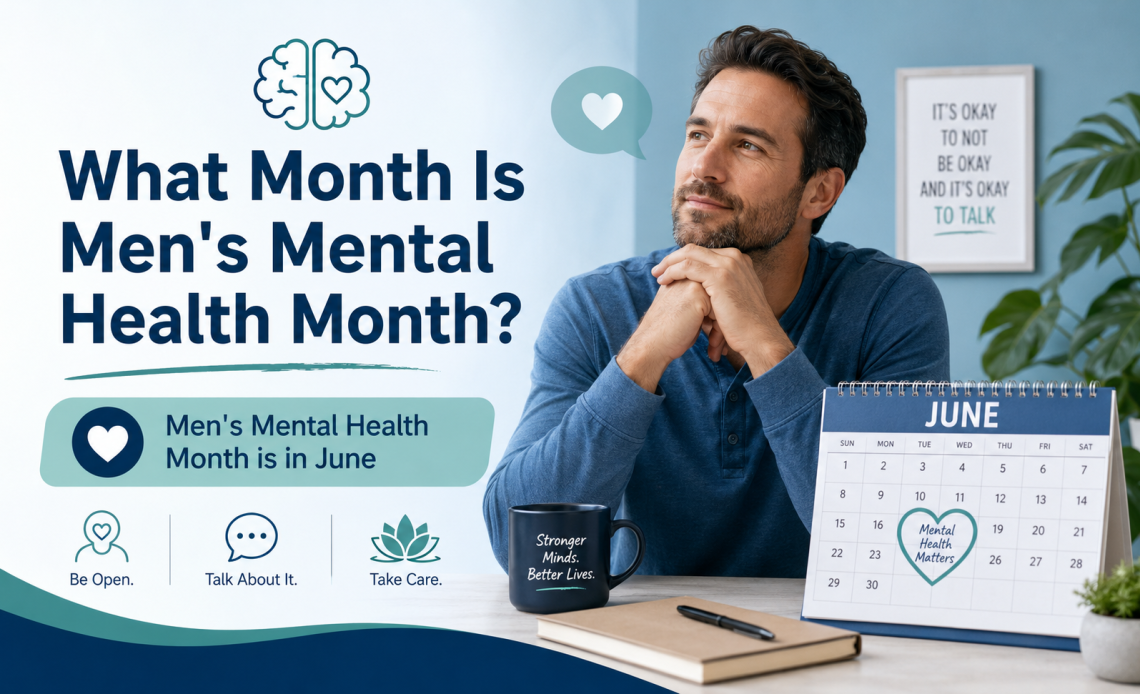
June is Men’s Mental Health Month in the United States. If you are asking what month is men’s mental health month, it is part of the broader Men’s Health Month, officially observed each June since 1994, and includes Men’s Health Week, which in 2026 runs from June 14 to 20. November also carries significant men’s mental health recognition internationally through Movember and International Men’s Day on November 19. The 2026 theme for Men’s Health Month is Partners in Care: Advancing Men’s Health Through Connection, Education, and Advocacy.
At a Glance
| Detail | Information |
| Men’s Mental Health Month (US) | June, officially Men’s Health Month since 1994 |
| Men’s Health Week 2026 | June 14 to 20, 2026 |
| 2026 Theme | Partners in Care: Advancing Men’s Health Through Connection, Education, and Advocacy |
| November Recognition | Movember campaign and International Men’s Day (November 19) |
| Key Statistic | Men are nearly four times more likely to die by suicide than women |
| Treatment Gap | Men are significantly less likely than women to seek or receive mental health treatment |
You’re Not Wrong to Be Confused by the Months
June comes up as Men’s Mental Health Month in US sources. November comes up in international and Movember-related coverage. Both are real. Both carry meaning. The confusion is understandable and worth sorting out before the actual point of either month gets lost in it.
Here is the full picture: which month is official and why, what November actually represents, and what the research says about why this awareness matters beyond an awareness calendar entry.
Is Men’s Mental Health Month in June or November?
In the United States, June is the official month. Men’s Health Month was established in 1994 under President Clinton’s administration with a mandate to raise awareness of the unique health challenges men face, including mental health, substance use, and shorter life expectancy.
November is associated with men’s health internationally, primarily through Movember, an annual campaign that began in Australia and has since spread globally. Movember focuses on prostate cancer, testicular cancer, and mental health. International Men’s Day also falls on November 19 each year.
The United Kingdom and Australia recognize November more prominently as Men’s Mental Health Awareness Month. So the answer depends on where you are and which organizations you follow. Within the United States, June is the correct answer.
What Is Movember and How Is It Different from Men’s Health Month?
Movember is a fundraising and awareness campaign where participants grow a moustache during November to draw attention to men’s health issues. It began in Australia in 2003 and has expanded to more than 20 countries.
Men’s Health Month in June is a US-based policy and public health initiative without a specific fundraising mechanism. It provides a framework for healthcare organizations, employers, community groups, and individuals to raise awareness and promote preventive care.
| Feature | Men’s Health Month (June) | Movember (November) |
| Origin | United States, 1994 | |
| Australia, 2003 | ||
| Primary audience | US-focused, international recognition growing | |
| Global, particularly strong in UK and Australia | ||
| Focus | Broad men’s health including mental health, preventive care | |
| Prostate cancer, testicular cancer, mental health, suicide prevention | ||
| Activity | Awareness events, healthcare promotion, employer initiatives | |
| Moustache growing, fundraising, community events | ||
Why Does Men’s Mental Health Need Its Own Month?
The statistics behind this question are significant enough to take seriously rather than treat as awareness-month boilerplate.
According to NAMI and the National Institute of Mental Health, men are nearly four times more likely to die by suicide than women. Research published in 2026 from First Therapy found that men account for 80 percent of all suicides, while only 17 percent of men see a therapist. A 2025 survey found that 40 percent of men have never spoken to anyone about their mental health, including friends, partners, or professionals.
Nearly one in five men experiences some form of mental health condition each year according to NIMH, yet men are significantly less likely than women to receive treatment. The gap between prevalence and help-seeking is the core problem that awareness months are designed to address.
Why Are Men Less Likely to Seek Mental Health Help?
The gap between how many men experience mental health challenges and how few seek help is not simply explained by stigma alone, though stigma is real and documented. Multiple overlapping factors make it harder for men to access and accept care:
- Cultural conditioning: generations of messaging that equates emotional expression with weakness. Phrases like “man up” communicate directly that distress is a personal failure rather than a health condition.
- Depression presents differently in men: male depression rarely looks like sadness. It more often shows up as irritability, overworking, risk-taking, increased alcohol use, or withdrawal. These are not symptoms most men or their loved ones recognize as depression.
- The search burden: finding a therapist requires researching, calling, waiting, and hoping for a good fit. For someone managing symptoms on top of work and family responsibilities, this process is a significant barrier.
- Limited peer modeling: men see fewer examples of other men openly seeking and benefiting from mental health support, which makes the decision feel more unusual than it is.
- Language mismatch: men are less likely to recognize their symptoms in the clinical language typically used to describe depression and anxiety, which is one reason Google searches for male depression symptoms grew 39 percent in 2025 without a corresponding increase in treatment rates.
What Does Depression Look Like in Men Specifically?
This is one of the most practically useful questions in men’s mental health, and one that does not get enough attention in general awareness messaging.
Male depression often does not look like the clinical picture most people carry in their heads. It rarely presents as visible sadness. It more commonly surfaces as:
- Irritability, anger, or aggression with a short trigger
- Overworking, staying busy as a way to avoid internal experience
- Increased alcohol consumption or substance use
- Risk-taking behavior that is out of character
- Withdrawing from relationships and social contact
- Physical complaints like chronic pain, headaches, or fatigue without clear cause
- Difficulty concentrating or making decisions
A man experiencing several of these is not necessarily going to label it depression, and neither will the people around him. This mislabeling is a key reason many cases go undiagnosed and untreated for years.
What Happens During Men’s Health Month in June?
Men’s Health Month is not a single event but a framework that organizations, employers, healthcare systems, and community groups use to run relevant programming during June.
Men’s Health Week falls within June, running June 14 to 20 in 2026, specifically timed to include Father’s Day on June 21. The week is designed as a concentrated push within the broader month for checkups, health screenings, and mental health conversations.
The official menshealthmonth.org produces an annual toolkit of shareable materials, social media graphics, and messaging guidance. In 2026 the toolkit is available for download with posts and resources organizations can adapt for their own channels.
Common activities during the month include:
- Employer wellness campaigns focused on men’s health resources
- Free or reduced-cost health screenings offered by clinics and community health organizations
- Mental health awareness events at workplaces, gyms, barbershops, and community centers
- Social media campaigns using the month to normalize help-seeking
How Can You Actually Support the Men in Your Life During This Month?
Awareness months are most useful when they translate into something specific that someone can do. A few approaches that go beyond sharing a post:
- Ask a real question and wait for the answer: not “how are you” but “how are you actually doing lately.” Then stay in the conversation rather than accepting a quick “fine.”
- Know the less obvious signs: if a man you know has become more irritable, is working excessively, or has pulled back from relationships, those are worth paying attention to even without classic depression symptoms.
- Remove the search barrier for them: if someone is open to therapy but has not acted on it, helping them identify a specific therapist rather than saying “you should talk to someone” lowers the activation energy significantly.
- Normalize it in everyday conversation: mentioning therapy or mental health care as something you do or have done reduces the sense that it is unusual or extreme.
- Create practical access not just awareness: workplaces can ensure employee assistance programs are visible and easy to use. Communities can provide low-cost options for men without adequate insurance coverage.
What Mental Health Resources Are Available Specifically for Men?
| Resource | What It Offers |
| 988 Suicide and Crisis Lifeline | Call or text 988 for crisis support, available 24 hours a day, seven days a week in the US |
| NAMI HelpLine | 1-800-950-NAMI, text NAMI to 741741 for mental health support and referrals |
| Veterans Crisis Line | Call 988 and press 1, text 838255, available for veterans and service members |
| Man Therapy (mantherapy.org) | A platform specifically designed around how men process and discuss mental health |
| Movember Foundation | Mental health resources alongside broader men’s health programming |
| Open Path Collective | Reduced cost therapy for individuals and families |
Is November Also a Men’s Mental Health Month?
In many countries outside the United States, yes. The United Kingdom and Australia recognize November as Men’s Mental Health Awareness Month, aligned with the Movember campaign and International Men’s Day on November 19.
Within the United States, November is not officially designated as Men’s Mental Health Month at a national level, though many organizations use Movember as a platform for mental health messaging. If you are searching for the US-official month, the answer is June. If you are following global campaigns, November carries significant weight.
Why Does the Month Even Matter if the Problem Exists Year Round?
This is a fair challenge and worth addressing honestly. Mental health awareness months work best when they serve as on-ramps rather than annual checkboxes. The value is not that the month cures anything. It is that concentrated attention creates a specific opening for conversations that otherwise do not happen.
For a man who has been considering therapy but has not acted, seeing multiple credible signals during June that this is normal and supported can be the moment that moves him from consideration to action. For an employer, the month provides a concrete reason to run a campaign they might otherwise delay indefinitely.
The limitation is also real: a month of awareness does not fix a system where men face real barriers to accessing care. The most meaningful version of Men’s Mental Health Month is one that uses June to open a door and keeps that door accessible on July 1 and every month after.
What Most People Don’t Realize About Men’s Mental Health Statistics
Most people are aware that men are reluctant to seek help. Fewer people know that when men do seek and receive mental health treatment, outcomes are comparable to those for women. The problem is not that treatment does not work for men. It is that men reach treatment at significantly lower rates and often at later stages of a mental health crisis than women.
A detail worth holding: Google searches for “male depression symptoms” grew 39 percent in 2025 without a corresponding increase in treatment rates. Men are looking. They are not finding themselves in the language being used, and many are not taking the next step. The awareness exists. The bridge between awareness and action is where the gap lives.
The Three Levels of Engagement With Men’s Mental Health Month
Whether you are an individual, an employer, or a community organization, engagement with this month works at three distinct levels:
- Level One, personal: have one genuine conversation with a man in your life this month. Not about the month, just a real check-in.
- Level Two, structural: if you have any influence over a workplace, school, or community organization, make the Employee Assistance Program or local mental health resources visible and easy to find this month.
- Level Three, systemic: advocate for and support organizations working to close the access gap: affordable therapy, telehealth options, and workplace mental health policies that normalize taking time for care.
All three matter. Level One is where most of the actual impact happens, one conversation at a time.
What Should You Do Next?
If you are a man who has been sitting with something difficult, this is the clearest possible invitation to say it out loud to someone you trust. Not because it is June. Because sitting with it silently costs more than asking for help.
If you are looking for a way to support someone else, start with a specific question rather than a general offer. “Let me know if you need anything” rarely gets used. “Are you doing okay, actually?” usually does.
If you are in crisis right now, call or text 988. That line is available around the clock and does not require having figured out what to say before you call.
Suggested Internal Links
Add these once matching pages exist on your site, using descriptive anchor text:
- Link to a men’s depression symptoms guide using anchor text like “how depression shows up differently in men”
- Link to a how to find a therapist guide using anchor text like “how to find the right therapist when you don’t know where to start”
- Link to a workplace mental health guide using anchor text like “how employers can support men’s mental health at work”