
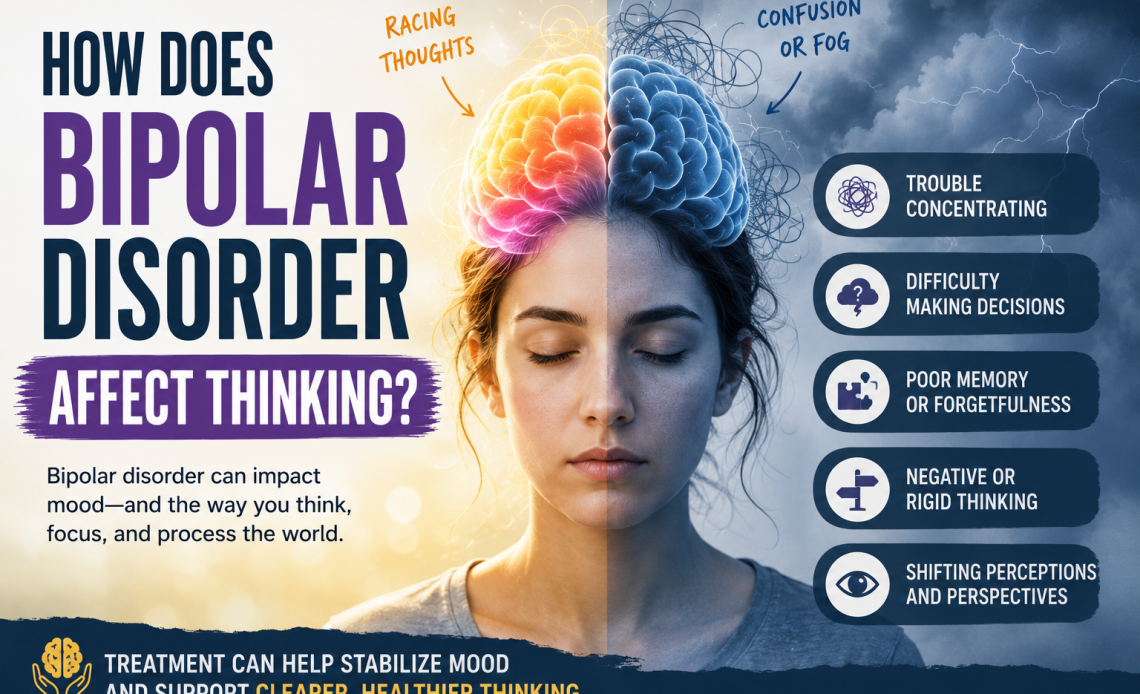
If you or someone you care about has bipolar disorder, the question how does bipolar disorder affect thinking can be just as important as questions about mood. Changes like trouble concentrating, losing track of conversations, or memory that feels less reliable than it used to can be disruptive and confusing to make sense of. This isn’t a personal failing or a lack of effort. Research increasingly treats these cognitive changes as a real, measurable feature of the condition itself, not just a side effect of mood.
Cognition and Mood Are Related, But Not the Same Thing
It’s easy to assume that thinking difficulties in bipolar disorder only happen during a manic or depressive episode, and then fully clear up in between. Research doesn’t fully support that assumption. Studies consistently find that attention, memory, and planning difficulties can persist even during euthymia, the more stable periods between mood episodes, which is part of why researchers now view cognitive functioning as its own dimension worth addressing directly, separate from mood symptoms.
How Thinking Tends to Shift Across Different Mood States
During Mania or Hypomania
Thoughts often move fast, sometimes described as racing, jumping quickly between ideas, or feeling hard to slow down or organize. Attention can become easily pulled in multiple directions at once, and impulsive decision-making becomes more common as the usual pause-and-evaluate step gets compressed or skipped.
During Depressive Episodes
Thinking often slows down rather than speeding up. This can look like difficulty concentrating, needing more time to process information, trouble finding words, and a kind of mental fog that makes even familiar tasks feel more effortful than usual. Memory, especially recalling things after a delay, is commonly affected during this phase.
Between Episodes (Euthymia)
This is the part that surprises a lot of people: even when mood is stable, difficulties with sustained attention, verbal memory, and executive function (the mental skills involved in planning, organizing, and adjusting to new information) can still show up for a meaningful portion of people with bipolar disorder. This is now understood as a trait-level feature for some individuals, not purely something tied to active mood symptoms.
Which Specific Areas of Thinking Are Most Often Affected
| Cognitive Domain | What It Can Look Like Day to Day |
| Attention | Difficulty staying focused on a task, conversation, or reading for extended periods |
| Verbal memory | Trouble recalling something you read or were told a short while ago |
| Executive function | Difficulty planning multi-step tasks, organizing, or adjusting when a plan changes |
| Processing speed | Needing more time than usual to think through or respond to something |
| Social cognition | Difficulty picking up on others’ emotional cues or tone in a conversation |
This Doesn’t Look the Same for Everyone
One of the more important, and reassuring, findings in this research area is just how much cognitive experience varies between individuals with bipolar disorder. Studies describing this variation generally find that people tend to fall into a few broad patterns: some show little to no measurable cognitive difficulty at all, some experience difficulty in a specific area like attention while other areas stay intact, and a smaller group experiences more widespread difficulty across several domains. There isn’t one universal experience, and having bipolar disorder doesn’t automatically mean someone will notice significant cognitive changes.
Why This Happens: A Brief, Plain-Language Look at the Brain Side
Researchers have linked these cognitive patterns to differences in brain regions involved in memory and emotional regulation, particularly the prefrontal cortex (involved in planning and decision-making) and the hippocampus (central to forming and storing memories). Imaging studies have also found that blood flow to these regions can shift along with mood state, which may help explain why cognitive symptoms can intensify during a mood episode even in people who function more typically between episodes.
Medication Can Play a Role Too
This is a detail that’s easy to overlook: some treatments used to manage bipolar disorder, including lithium and, in some cases, electroconvulsive therapy, can themselves affect thinking and memory as a side effect. This doesn’t mean treatment should be stopped or avoided, since untreated mood episodes carry their own serious risks, but it’s a legitimate and important thing to raise with a prescribing doctor if cognitive side effects are significant, since adjustments or alternative options are sometimes available.
What Can Help
- Treating and stabilizing mood episodes, since cognitive symptoms are closely tied to overall illness course
- Cognitive remediation therapy, a structured, research-backed approach specifically designed to improve attention, memory, and executive function in people with bipolar disorder
- Psychoeducation programs, which have been shown to help predict better occupational functioning over time
- Practical daily strategies like using written reminders, breaking tasks into smaller steps, and reducing multitasking during demanding periods
- Open conversations with a psychiatrist about whether current medications may be contributing to cognitive symptoms, and whether adjustments are worth exploring
When to Talk to a Doctor
It’s worth raising cognitive changes with a psychiatrist or treatment team if concentration, memory, or organization difficulties are affecting work, school, or relationships, if these difficulties feel new or worsening, or if you’re noticing them even during periods when mood feels otherwise stable. Cognitive symptoms are a legitimate, treatable-adjacent part of the overall clinical picture, not something to just push through quietly.
A Note on How to Read This Information
Descriptions like these are meant to help make sense of a real and researched pattern, not to serve as a checklist for self-diagnosis. Thinking difficulties have many possible causes, including stress, sleep, other health conditions, and normal day-to-day variation, so if you’re noticing these changes in yourself or someone you care about, a conversation with a psychiatrist, therapist, or neuropsychologist is the most reliable next step, not matching symptoms to a list.
Frequently Asked Questions
Does bipolar disorder always affect thinking and memory?
No. Research finds a range of outcomes: some people show no measurable cognitive difficulty, some have trouble in one specific area, and a smaller group experiences more widespread effects across multiple areas of thinking.
Do cognitive symptoms go away once mood is stable?
Not necessarily. Studies show that attention, memory, and executive function difficulties can persist during periods of stable mood for some people, which is why they’re increasingly treated as a separate feature of the condition rather than purely a mood symptom.
Can medication for bipolar disorder affect thinking?
Yes, some treatments, including lithium and, in certain cases, electroconvulsive therapy, can affect memory and cognitive processing as a side effect, which is worth discussing with a prescribing doctor.
Is there treatment specifically for cognitive symptoms in bipolar disorder?
Cognitive remediation therapy is a structured approach being studied and used specifically to address attention, memory, and executive function difficulties in bipolar disorder, alongside standard mood-focused treatment.
Does cognitive difficulty in bipolar disorder get worse over time?
Most research suggests cognitive deficits tend to remain relatively stable over time rather than steadily worsening, though findings on this vary somewhat between studies and individuals.
Who can help if I’m noticing thinking or memory changes?
A psychiatrist or treatment team is a good starting point, and a referral to a neuropsychologist can help clarify which specific areas of thinking may be affected and what support options exist.
This article is for general educational purposes only and is not a diagnostic tool or a substitute for professional mental health care. If you have questions about your own or a loved one’s symptoms, a psychiatrist, therapist, or neuropsychologist can help.