
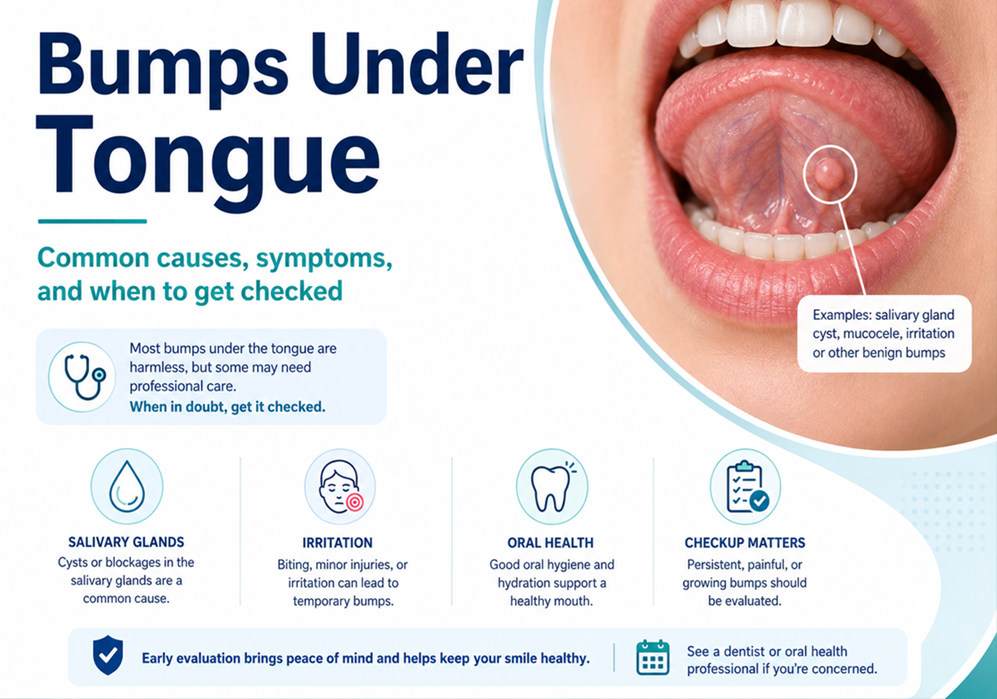
Bumps under tongue are usually harmless and temporary. The most common causes are canker sores (aphthous ulcers), mucoceles (blocked salivary gland cysts), ranulas (a larger version of a mucocele specific to the floor of the mouth), irritation from food or trauma, and salivary stones. Most resolve on their own within one to two weeks. A bump that persists beyond two to three weeks, grows, bleeds without cause, or is accompanied by difficulty swallowing or speaking should be evaluated by a doctor or dentist promptly.
Bumps Under Tongue at a Glance
| Factor | Details |
| Most Common Causes | Canker sores, mucoceles, ranulas, irritated papillae, salivary stones, minor trauma |
| Less Common Causes | HPV, oral herpes, syphilis, oral thrush, nutritional deficiency, oral cancer |
| Who Gets Them | Anyone at any age, very common, usually benign |
| Typical Appearance | Small white, red, yellow, or clear bump; may be soft, fluid-filled, or firm |
| Typical Duration | One to two weeks for most benign causes; ranulas and mucoceles may persist longer |
| Pain Level | Canker sores are often painful; mucoceles and ranulas are usually painless; salivary stones can cause pain during meals |
| Self-Resolving | Canker sores, mild irritation, and some mucoceles resolve without treatment |
| Needs Treatment | Ranulas, persistent mucoceles, salivary stones, HPV, herpes, thrush, syphilis, oral cancer |
| Home Relief | Saltwater rinse, good oral hygiene, avoiding irritating foods, OTC pain relief |
| When to See a Doctor | Bump persists beyond 2 to 3 weeks, grows, bleeds, is painless and hard, or causes difficulty swallowing |
| Red Flag Signs | Painless hard lump, ulcer that does not heal, lump with irregular edges, unexplained numbness, voice changes |
Found a Bump Under Your Tongue? Here Is What It Probably Is
You felt something unfamiliar while eating, or noticed it when you lifted your tongue in the mirror. A small bump, maybe soft, maybe firm, maybe sore. The internet will show you a very wide range of possibilities when you search for it, and most of them will alarm you far more than the situation warrants.
Here is the honest framing: the vast majority of bumps that appear under the tongue are benign, temporary, and resolve on their own within a week or two. Canker sores, minor cysts from blocked salivary glands, and small trauma from biting or sharp food account for the overwhelming majority of cases.
That said, a small number of bumps under the tongue do need attention. Knowing the difference between what is harmless and what needs a clinical eye is the genuinely useful thing this article will give you.
What Are the Most Common Causes of Bumps Under the Tongue?
The underside of your tongue and the floor of your mouth are home to several salivary gland openings, blood vessels, and delicate mucous membrane tissue. This makes the area more prone to certain types of bumps than almost any other part of the mouth.
| Type of Bump | What It Looks Like | Painful? | How Long It Lasts | Needs Treatment? |
| Canker Sore (Aphthous Ulcer) | White or yellow oval ulcer with a red border; flat or slightly sunken | Yes, often quite painful | Seven to fourteen days typically | Not usually; OTC gels can reduce discomfort |
| Mucocele | Soft, smooth, dome-shaped bump; usually clear or bluish; fluid-filled | Rarely painful | May resolve in a few weeks; often recurs | Persistent ones need minor surgical removal |
| Ranula | Larger fluid-filled cyst on the floor of the mouth; bluish and translucent; often under the tongue | Usually painless unless infected | Does not self-resolve reliably; tends to grow | Yes; marsupialization or surgical removal |
| Salivary Stone (Sialolithiasis) | Hard lump near a salivary gland opening; may not be visible but is felt as a lump | Yes, especially during eating when saliva flow increases | Can persist until the stone passes or is removed | Yes; massage, hydration, or surgery |
| Irritated / Swollen Papillae (Lie Bumps) | Small red or white bumps; may appear in clusters; often on the tip or underside of tongue | Yes, mild to moderate sensitivity | Two to four days typically | No; self-resolving |
| Fibroma | Firm, flesh-coloured, smooth lump; usually does not change colour | Not typically painful | Does not self-resolve | Minor surgical excision if bothersome |
| Oral Herpes (HSV-1) | Cluster of small fluid-filled blisters; may appear in groups and then crust over | Yes, can be quite sore | Seven to ten days per outbreak | Antiviral medication reduces duration and frequency |
| Oral Thrush (Candidiasis) | White patches or creamy coating; may appear as raised spots under or on the tongue | May cause soreness or burning | Persists without treatment | Yes; antifungal medication prescribed by a doctor |
| HPV Wart (Oral HPV) | Soft, flesh-coloured or pink cauliflower-like growth; painless | Rarely painful | May resolve; may persist or grow | Cryotherapy or surgical removal |
| Salivary Gland Tumour | Firm, slow-growing lump near a salivary gland; may feel fixed | Variable; often painless early on | Does not self-resolve | Urgent surgical assessment required |
| Oral Cancer | Persistent sore, ulcer, or lump that does not heal; may be white, red, or mixed; irregular edges | May be painless initially; this is a key warning sign | Does not self-resolve | Urgent referral; biopsy required |
Canker Sores Under the Tongue: Why They Appear and What to Do
Canker sores are the single most common cause of bumps and painful spots under the tongue. They are small ulcers that develop in the soft tissue inside the mouth, including the floor of the mouth and the underside of the tongue where the tissue is thin and delicate.
Despite being extremely common, the exact cause is still not fully understood. Triggers include physical trauma (biting the inside of your mouth, sharp food edges), stress, hormonal changes, certain foods (citrus, tomatoes, spicy foods), nutritional deficiencies in B12, iron, or folic acid, and in some people, sodium lauryl sulfate in toothpaste.
They are not contagious. They appear as white or yellowish oval ulcers with a red inflamed border, and they tend to hurt disproportionately to their size. The good news is that they almost always resolve on their own within seven to fourteen days without any treatment.
To reduce discomfort, rinse with warm saltwater two to three times daily, apply a topical OTC benzocaine gel to numb the area, avoid acidic or spicy foods during healing, and maintain gentle oral hygiene. If you get canker sores frequently, a doctor can investigate whether a nutritional deficiency or underlying condition is contributing.
What Is a Mucocele and What Is a Ranula? How Are They Different?
These two conditions are related but distinct, and they are both among the most commonly found bumps under the tongue.
A mucocele forms when a minor salivary gland gets blocked or damaged, usually from biting or lip sucking, causing saliva to pool and form a cyst. It typically appears as a soft, smooth, dome-shaped bump that is clear or slightly bluish in colour. Mucoceles are usually painless and can appear anywhere in the mouth where minor salivary glands are located.
A ranula is essentially a mucocele that forms specifically on the floor of the mouth from one of the major sublingual or submandibular salivary glands. Because it involves a larger gland, it tends to be bigger than a typical mucocele and has a more pronounced bluish appearance. Ranulas can become quite large and may interfere with speaking or swallowing if left untreated.
While some small mucoceles resolve on their own if the blocked gland reopens, ranulas rarely self-resolve and typically require a procedure called marsupialization, where the cyst is opened and the lining is stitched back to allow permanent drainage. Cleveland Clinic recommends seeing a healthcare provider if a lump under the tongue does not go away or gets bigger.
| Feature | Mucocele | Ranula |
| Source | Minor salivary gland (small glands throughout the mouth) | Major sublingual or submandibular gland (under the tongue specifically) |
| Typical size | Usually small, a few millimetres | Often larger, can grow to several centimetres |
| Appearance | Soft, smooth, dome-shaped, clear or bluish | Larger fluid-filled cyst, more noticeably bluish and translucent |
| Location | Anywhere in the mouth; often inside the lip | Specifically on the floor of the mouth and under the tongue |
| Pain | Usually painless | Usually painless; may cause discomfort if large |
| Self-resolving | Sometimes; smaller ones may resolve | Rarely self-resolves; tends to persist and grow |
| Treatment | Watch and wait; excision if persistent | Marsupialization or surgical removal typically needed |
Could It Be a Salivary Stone? What You Need to Know
Salivary stones, medically called sialoliths, form when minerals in saliva crystallise and block one of the salivary ducts. The blockage causes saliva to back up into the gland, creating swelling and a lump that is typically felt rather than seen under the tongue.
The telltale symptom is pain and swelling that gets noticeably worse at mealtimes, when saliva production increases. If you notice a lump under your tongue that swells and hurts specifically when you eat or smell food, a salivary stone is high on the list of likely causes.
Small stones sometimes pass on their own with adequate hydration, gentle massage of the gland, and stimulating saliva flow with sour foods or sugar-free lemon candy. Larger stones may need a doctor to probe and remove them, or in some cases surgery. Anti-inflammatory medication reduces the associated swelling and discomfort while the stone is being managed.
When Should a Bump Under Your Tongue Actually Worry You?
The reassuring answer is that most bumps under the tongue do not need to worry you. The uncomfortable truth is that a small number of oral cancers present exactly as bumps or ulcers under the tongue that people mistake for canker sores and wait on for weeks before getting checked.
Oral cancer under the tongue is one of the less visible and therefore more frequently missed locations. The underside of the tongue and the floor of the mouth account for a disproportionate share of oral cancers relative to their surface area. This is not to say every bump is cancer. It is to say that the specific warning signs listed below genuinely deserve prompt attention.
| See a Doctor or Dentist if You Notice Any of These A bump or ulcer that has not healed after two to three weeks. A lump that is painless and hard (painless lumps in the mouth are more concerning than painful ones, not less). Bleeding from the bump without obvious trauma. Difficulty swallowing, chewing, or moving your tongue. Unexplained numbness in the tongue or floor of the mouth. White or red patches that cannot be wiped off. Rapid growth of any lump in the mouth. A lump accompanied by a swollen lymph node in the neck. Any lump after oral sexual contact that was not there before. |
These are not guaranteed signs of cancer. They are signs that something beyond a canker sore or minor cyst is happening, and the only way to know for certain is a clinical examination and potentially a biopsy. Catching oral cancer early dramatically improves outcomes.
What Can You Do at Home to Help a Bump Under Your Tongue Heal?
For the majority of bumps that are minor, temporary, and not in the red flag category, these are the home measures that make the most meaningful difference.
- Saltwater rinse twice daily. Dissolve half a teaspoon of salt in a glass of warm water and rinse for thirty to sixty seconds, then spit. Saltwater is mildly antiseptic, reduces inflammation, and promotes healing of soft tissue in the mouth. It is the single most broadly useful home treatment for any type of oral bump.
- Avoid irritating the area further. Acidic foods (citrus, vinegar, tomato), spicy foods, and hard or crunchy textures can reinjure already irritated tissue and slow healing. While the bump is present, favour softer, mild-temperature foods and be cautious with toothbrush contact around the area.
- Apply OTC topical treatments for canker sores. Products containing benzocaine (a topical anaesthetic) or amlexanox can reduce pain and accelerate healing of canker sores. They are available at pharmacies without a prescription and applied directly to the bump with a cotton swab. These are only useful for canker sores, not for cysts or other types of bumps.
- Stay hydrated. Good hydration keeps saliva flowing, which helps prevent salivary gland blockages and promotes the natural cleansing of the mouth. It is especially relevant if salivary stones or mucoceles are suspected.
- Do not attempt to pop, drain, or cut a cyst yourself. Mucoceles and ranulas look tempting to pop because they appear similar to a fluid blister. Do not do it. Breaking the cyst yourself introduces bacteria and significantly increases infection risk. Even if the cyst drains, it almost always refills because the underlying blocked gland is still present. A dentist or doctor drains these in a controlled setting with appropriate technique.
- Maintain standard oral hygiene gently. Keep brushing and flossing, but be careful around the bump. Letting oral hygiene slip to avoid the area allows bacterial buildup that can complicate healing. Soft-bristle toothbrushes are gentler on inflamed tissue.
How Do You Know Which Type of Bump You Have?
| If the bump is… | It is most likely… | What to do next |
| Painful, white or yellow with a red border, flat or sunken | Canker sore (aphthous ulcer) | Saltwater rinse, OTC benzocaine gel, wait seven to fourteen days, see a doctor if it has not healed |
| Soft, dome-shaped, clear or bluish, painless | Mucocele or ranula | Monitor for two to three weeks; see a dentist if it persists, grows, or affects eating or speaking |
| Hard lump near the salivary duct, worse pain when eating | Salivary stone | Hydrate well, try gentle massage, see a doctor if it does not resolve within a week |
| Cluster of small fluid blisters, sore, may crust over | Oral herpes (HSV-1) | See a doctor for antiviral medication; avoid sharing utensils or kissing during an outbreak |
| White, creamy patches that feel sore or burned | Oral thrush (candidiasis) | See a doctor for antifungal treatment; check for underlying immune or diabetes-related causes |
| Flesh-coloured, cauliflower-like growth, painless | HPV wart | See a doctor; treatment with cryotherapy or surgical removal |
| Firm, flesh-coloured, does not change, not painful | Fibroma from chronic irritation | See a dentist; minor excision if bothersome |
| Has not healed in over two weeks, painless, hard, with irregular edges | Possible oral cancer or salivary gland tumour | See a doctor or dentist urgently; do not delay |
What Do People Get Wrong About Bumps Under the Tongue?
- If it does not hurt, it is nothing to worry about. This is one of the most dangerous misconceptions about oral health. Painless lumps in the mouth are actually more concerning than painful ones in many cases. Canker sores and infected bumps hurt. Early oral cancers, HPV warts, and salivary gland tumours are frequently painless. The absence of pain is not reassurance.
- Canker sores and cold sores are the same thing. They are completely different conditions. Canker sores are non-contagious ulcers that appear inside the mouth and are not caused by a virus. Cold sores are caused by HSV-1, are contagious, appear on the outer lip or at the lip border, and produce blisters that crust over. Oral herpes can occasionally appear inside the mouth but is distinct from canker sores both in appearance and cause.
- Popping a cyst under the tongue will make it go away. It will not. Mucoceles and ranulas form because the underlying salivary gland duct is blocked or damaged. Popping or draining the cyst at home does not address the blocked gland, so the cyst almost always refills. It also introduces bacteria into a broken tissue surface and significantly raises infection risk.
- A bump that comes back in the same spot is just another canker sore. Canker sores do tend to recur in people who are prone to them, but a lump that consistently reappears in exactly the same location is worth investigating by a dentist. Persistent recurrence in one spot can indicate a chronic irritant, a recurring cyst, or in rarer cases, something more serious.
- Bumps under the tongue in children are not serious. Children can develop ranulas, mucoceles, canker sores, and in some cases, more significant conditions. A bump under a child’s tongue that persists, grows, or causes difficulty feeding or speaking deserves dental or medical assessment.
Questions People Keep Searching About Bumps Under the Tongue
Is it normal to have bumps under your tongue? Yes. The underside of the tongue has small naturally occurring folds, minor salivary gland openings, and visible veins that can look alarming but are entirely normal anatomy. If you are looking at a bump that was not there before, that is different from normal anatomy and warrants monitoring.
How long does a bump under the tongue take to go away? Canker sores typically resolve in seven to fourteen days. Irritated papillae or lie bumps usually clear in two to four days. Mucoceles vary widely; some resolve in a few weeks while others persist for months. A bump that has not changed or healed after two to three weeks is the threshold at which a clinical evaluation is warranted.
Can a bump under the tongue be a sign of cancer? In a small number of cases, yes. The floor of the mouth and the underside of the tongue are areas where oral cancers do occur. Warning signs that distinguish a potentially serious lump from a benign one include persistence beyond two to three weeks, a hard and painless quality, irregular edges, inability to be moved when pressed, bleeding without trauma, and any associated swelling in the neck. See a dentist or doctor for anything that fits this description.
Can stress cause bumps under the tongue? Stress is a well-recognised trigger for canker sores in people who are prone to them. It does not cause all types of bumps, but if you notice that mouth ulcers tend to appear during high-stress periods, this is a genuine and documented connection. Managing stress, ensuring adequate sleep, and maintaining B12 and iron levels all reduce canker sore frequency in susceptible individuals.
Do bumps under the tongue mean I have an STI? Not automatically. The vast majority of bumps under the tongue have nothing to do with sexual transmission. However, oral HPV, oral herpes (HSV-1 and occasionally HSV-2), and syphilitic chancres can appear in the mouth including under the tongue. If you have had oral sexual contact and develop a new bump shortly afterward, discussing this with a doctor and considering STI testing is a reasonable step.
When should a child with a bump under the tongue see a doctor? If the bump has been present for more than two weeks, appears to be growing, is causing difficulty eating, speaking, or swallowing, or is accompanied by fever or other symptoms, a paediatric dentist or doctor should evaluate it. The eruptive type of transient lingual papillitis can affect children and may involve the tongue becoming swollen and bumpy, which is worth having assessed.
What Most Articles About Bumps Under the Tongue Get Wrong
Most content on this topic either dismisses all bumps as harmless canker sores or alarmes readers with a long list of serious conditions presented without context about how common each one actually is. Neither approach is useful.
The more nuanced truth is that location and duration are the two most clinically important variables, and they are rarely discussed together. A bump in the same spot where you recently bit your cheek, that appeared the next morning and is sore, is almost certainly minor trauma. A bump in the same location that appeared without any obvious cause, is painless and firm, and has been there for three weeks is a different situation entirely.
The other thing that gets consistently underemphasised is the importance of the painless quality. Most people use pain as their primary gauge of whether something is serious. In the mouth, this heuristic works backwards from what you might expect. Canker sores, which are harmless, can be exquisitely painful. Early oral cancers, salivary gland tumours, and HPV lesions are very frequently painless. A painless bump that you found by accident is not reassuring just because it does not hurt.
Most people also do not realise that the floor of the mouth and the underside of the tongue are the highest-risk anatomical zones for oral cancer in the mouth. This is partly because they are areas that most people never look at unless something draws their attention there. An annual dental examination includes an oral cancer screen that covers these areas. If you do not have regular dental check-ups, that is the most important preventive step for catching any concerning change early.
What to Do Next Based on What You Are Dealing With
If you noticed a bump under your tongue recently and it is sore, appeared after eating something acidic or crunchy, and looks like a small white or yellowish ulcer, you most likely have a canker sore. Rinse with saltwater twice daily, treat the discomfort with an OTC topical gel, and give it one to two weeks to resolve.
If the bump is soft, fluid-filled, and painless and has been there for more than a couple of weeks without change, it is likely a mucocele or ranula. See a dentist. These do not resolve with home treatment and are easy to address with a minor procedure when they do not self-resolve.
If the bump has been there for more than two to three weeks and you are not sure what it is, or if it fits any of the warning signs in the red flag box earlier in this article, book a dental or medical appointment this week. The most common outcome of that appointment is reassurance and a simple diagnosis. The cost of not going when something is actually developing is much higher.
Oral health is one of the areas where early attention produces the best outcomes and delayed attention produces the worst ones. The vast majority of bumps under the tongue are nothing. But a thorough two-minute look by a clinician is the only way to be certain which category yours falls into.
Myth vs. Reality at a Glance
| Myth | Reality |
| If it does not hurt, it is not serious | Painless bumps are often more concerning than painful ones. Canker sores hurt. Early oral cancers and HPV lesions are frequently painless. |
| Bumps under the tongue always mean canker sores | Canker sores are common but mucoceles, ranulas, salivary stones, HPV, herpes, and other conditions all present similarly and have different treatments. |
| Popping a cyst helps it heal | Popping a mucocele or ranula introduces bacteria and does not fix the blocked gland. It almost always refills and increases infection risk. |
| A bump in the same spot must be a recurring canker sore | A bump that consistently recurs in exactly the same location warrants investigation. Chronic irritation, recurring cysts, or more serious conditions can present this way. |
| Two weeks is too soon to see a doctor about a mouth bump | Two to three weeks is the clinical threshold at which a bump that has not healed warrants professional evaluation, not a reason to keep waiting. |