
Key Takeaways
- Deep sleep (stage N3) is the most physically restorative sleep stage, supporting tissue repair, immune function, growth hormone release, and memory consolidation.
- You cannot directly control your sleep stages, but sleep restriction therapy, done with professional guidance, is the only scientifically proven method to increase deep sleep.
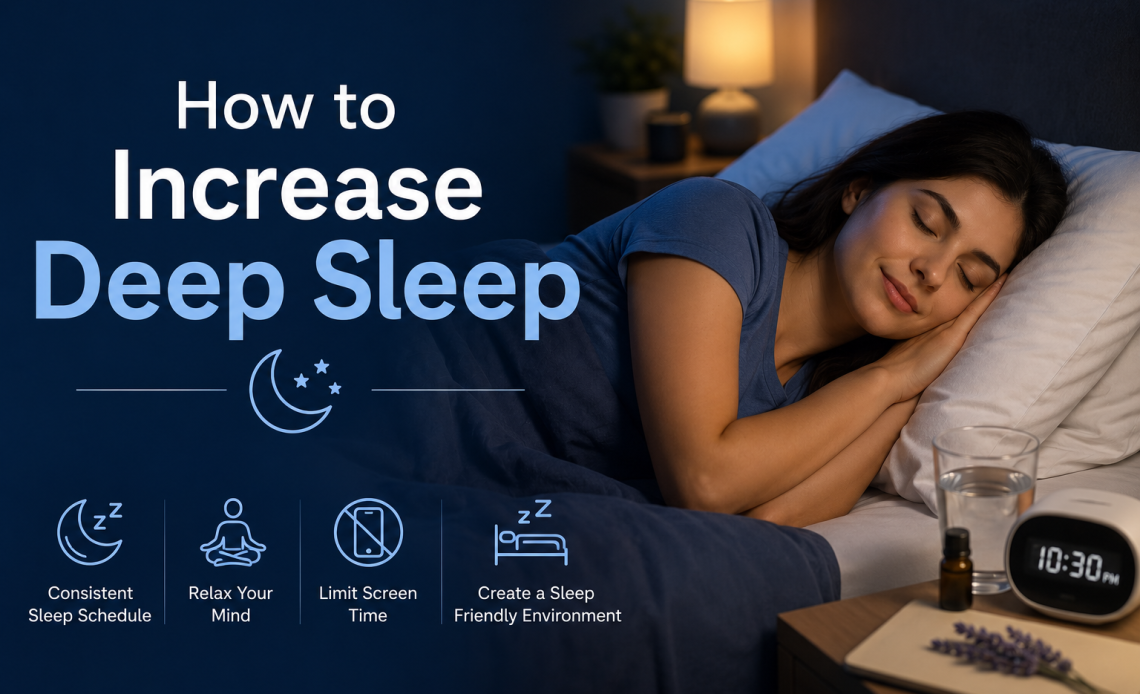
- Consistent sleep and wake times, a cool dark quiet bedroom, regular daytime exercise, and stress management routines all support deeper, more restorative sleep.
- Consumer sleep trackers are useful for spotting overall patterns but regularly overestimate deep sleep, and obsessing over nightly scores can make sleep worse.
- Persistent unrefreshing sleep, loud snoring, chronic insomnia, or excessive daytime sleepiness should prompt a conversation with a doctor about underlying sleep disorders.
If you use a sleep tracker, you already know exactly how much deep sleep you get each night. What most apps and wearables do not tell you is whether those numbers are accurate, or what you can actually do to change them. According to the National Sleep Foundation, one to two hours of deep sleep per night is what the average adult needs to feel genuinely restored. But knowing how to increase deep sleep is not as simple as going to bed earlier or taking a supplement. The strategies that actually work are grounded in sleep science, and some of them are counterintuitive. We asked sleep specialists to explain what deep sleep does, what happens when you are not getting enough, and which approaches have real evidence behind them. For patients in Central New Jersey managing sleep concerns alongside other health conditions, the clinical team at Capital Health Hopewell provides evaluation and support for sleep disorders and their connections to overall health.
What Is Deep Sleep
Each night your body moves through four stages of sleep: non-rapid eye movement stages N1 and N2, followed by deep sleep (N3), and then REM sleep. Most adults cycle through this sequence four to six times per night, with each cycle lasting roughly 90 minutes. Deep sleep, also called slow-wave sleep, is the stage where brain waves slow to their lowest frequency, heart rate and breathing reach their most reduced levels, and the body performs its most intensive repair work.
During deep sleep, the pituitary gland releases the majority of its daily growth hormone output, which drives tissue repair, muscle recovery, and cellular renewal. The immune system is also most active during this stage, producing and distributing cytokines that help the body fight infection and inflammation. Deep sleep is additionally the stage most responsible for memory consolidation, the process by which the brain transfers information from short-term storage to long-term memory.
Deep sleep is most concentrated in the first half of the night. If you go to bed at 11 pm and wake at 7 am, most of your deep sleep will occur between 11 pm and 3 am. This is one reason that shifting to a later bedtime, even if total sleep hours are preserved, can meaningfully reduce deep sleep.
Signs You Are Not Getting Enough Deep Sleep
Your body sends reliable signals when deep sleep is consistently insufficient. Sleep specialists identify the following as the most common indicators:
- Difficulty waking up. Beyond the normal grogginess of the first 15 to 60 minutes after waking, struggling to fully wake up and function despite adequate hours in bed is a common sign of poor sleep quality.
- Persistent low energy. Relying on caffeine throughout the day to stay functional, or feeling physically drained by mid-afternoon, often reflects insufficient restorative sleep rather than simply a long day.
- Increased forgetfulness. Difficulty retaining new information, losing track of recent conversations, or struggling to recall details are well-documented consequences of reduced deep sleep and its effect on memory consolidation.
- Impaired coordination. Clumsiness, slower reaction times, and reduced fine motor control can emerge when deep sleep is chronically reduced, because physical recovery and motor memory consolidation depend on this stage.
- Mood changes. Irritability, emotional reactivity, and heightened sensitivity to stress are associated with inadequate deep sleep, which plays a regulatory role in emotional processing.
- Slower thinking. Cognitive speed, problem-solving ability, and sustained attention all suffer when deep sleep is insufficient, even when total sleep time appears adequate.
How to Increase Deep Sleep
The most important thing to understand upfront is that you cannot directly command your brain to spend more time in deep sleep. What you can do is create the conditions under which deep sleep occurs more reliably, and in one specific clinical context, use a supervised technique that produces measurable increases in slow-wave activity.
Sleep Restriction Therapy
Outside of treating an underlying sleep disorder, sleep restriction therapy is the only scientifically proven method to increase deep sleep, and it works through a mechanism that surprises most people. When sleep is carefully reduced by 30 to 60 minutes over one to several nights, the body accumulates sleep pressure (adenosine buildup) that causes rebound sleep the following night to be significantly richer in slow-wave activity. Research published in the Journal of Clinical Sleep Medicine confirmed that restricting sleep over multiple nights increases slow-wave activity even when total sleep time is reduced. Sleep restriction therapy is most commonly used as a component of cognitive behavioral therapy for insomnia (CBT-I) and should always be done under the guidance of a trained sleep specialist rather than self-administered.
Consistent Sleep and Wake Times
Your body runs on a circadian rhythm, an internal 24-hour biological clock that regulates the timing and architecture of your sleep stages. When that clock is disrupted, by staying up late on weekends and sleeping in on Sunday mornings, for example, deep sleep is among the first casualties. Keeping a fixed wake time, even on days off, anchors the circadian clock and allows the brain to reliably enter deep sleep at the right point in the night. Going to bed and waking at consistent times is one of the simplest and most consistently supported sleep hygiene practices in the research literature.
A Sleep-Supportive Environment
The physical environment of your bedroom has a direct effect on sleep architecture. According to the Cleveland Clinic, the optimal bedroom temperature for sleep is 60 to 67 degrees Fahrenheit (15 to 19 degrees Celsius). Core body temperature naturally drops at sleep onset, and a cool room supports and accelerates that process. Darkness is equally important: the NIH National Heart, Lung, and Blood Institute explains that darkness signals the brain to release melatonin, the hormone that promotes sleep onset and supports sleep architecture. Blackout curtains, an eye mask, and a white noise machine or earplugs to mask environmental sound can meaningfully improve the depth and continuity of sleep.
Stress Management and Wind-Down Routines
Psychological stress directly interferes with deep sleep. A study published in Frontiers in Psychology found that stress and rumination before sleep increased sleep latency (the time it takes to fall asleep) and reduced early slow-wave sleep. Elevated cortisol, the stress hormone, suppresses the slow-wave activity that defines deep sleep. Building a consistent wind-down routine in the 30 to 60 minutes before bed, whether through light stretching, reading, breathing exercises, or a warm bath, signals to the nervous system that the alerting phase of the day is ending. The drop in core body temperature after a warm bath also mirrors the physiological cue that initiates sleep onset.
Regular Exercise at the Right Time
Physical activity is one of the most consistently supported environmental drivers of deep sleep quality. A systematic review published in Cureus found that regular exercise improves both sleep duration and quality, with effects including increases in slow-wave sleep. The likely mechanisms include exercise-driven increases in adenosine (sleep pressure), reduced cortisol over time, and improved circadian rhythm regulation. Timing matters significantly, however. A 2025 study published in Nature Communications found that exercising too close to bedtime, particularly intense cardiovascular or resistance training within two hours of sleep, can delay sleep onset, reduce total sleep time, and fragment sleep architecture. Morning or early afternoon exercise produces the strongest sleep benefits.
Pink Noise
An emerging area of sleep research involves the use of pink noise, a sound profile that mimics natural sounds like rainfall or flowing water, timed to coincide with the slow oscillations of deep sleep. Studies published in the Annals of Clinical and Translational Neurology and in Sleep Medicine found increases in slow-wave activity of approximately 18 percent in some participants after one night of timed acoustic stimulation. Results are variable: the intervention works well for some people and produces little effect in others, and most studies to date involve small sample sizes. It is a low-risk approach worth exploring but should be understood as a complement to foundational sleep habits rather than a primary strategy.
Avoiding Late Caffeine and Evening Screens
Caffeine has a half-life of five to seven hours in most adults, meaning that a cup of coffee at 3 pm still has a meaningful concentration in the bloodstream at 9 pm. Caffeine blocks adenosine receptors, reducing sleep pressure and making sleep lighter and more fragmented. The practical guideline supported by sleep researchers is to stop caffeine intake by early afternoon, around 1 to 2 pm, to avoid its interference with sleep onset and sleep architecture. Screens are a separate but related issue: the CDC confirms that blue light emitted by phones, tablets, and laptops suppresses melatonin and delays the circadian shift toward sleep, effectively signaling to the brain that it is still daytime. Switching to low-light, warm-tone activities in the hour before bed protects the melatonin signal that initiates and sustains deep sleep.
When Poor Deep Sleep Is a Medical Issue
Occasional poor sleep is normal and not a reason for concern. When disrupted or unrefreshing sleep becomes a persistent pattern that affects daily functioning, it often reflects an underlying sleep disorder that lifestyle changes alone will not resolve.
The following patterns should prompt a conversation with a doctor:
- Feeling unrefreshed consistently despite spending adequate hours in bed
- Loud snoring or gasping sounds during sleep, which may indicate sleep apnea
- An irresistible urge to move the legs at night, particularly one that worsens at rest
- Chronic difficulty falling or staying asleep despite good sleep habits
- Falling asleep involuntarily at inappropriate times during the day
- Needing frequent long daytime naps to compensate for nighttime sleep
These patterns are associated with diagnosable conditions including obstructive sleep apnea, restless legs syndrome, circadian rhythm disorders, and insomnia disorder, all of which have specific and effective treatments that go well beyond sleep hygiene.
How Accurate Is Deep Sleep Tracking
More than one in three Americans have used an electronic sleep tracker, according to a 2023 survey by the American Academy of Sleep Medicine. Consumer wearables are generally reliable at detecting sleep versus wakefulness, but struggle significantly at distinguishing between sleep stages. Compared to polysomnography (the gold-standard in-lab sleep study), wearables tend to overestimate both light and deep sleep. A study published in JMIR mHealth and uHealth comparing 11 sleep trackers found wide variation in accuracy across devices, with no single consumer product matching clinical-grade measurement for sleep stage identification.
Sleep specialists are also noting a rise in orthosomnia, a term for sleep anxiety driven by obsessive monitoring of tracker scores. When people spend significant energy trying to optimize their sleep app numbers, the cognitive arousal that creates can actually worsen sleep quality. Trackers are most useful as a broad behavioral prompt, for maintaining consistent sleep schedules, for example, rather than as a precise medical measurement of sleep stage biology.
Bottom Line
Deep sleep is the body’s most restorative stage, and while you cannot directly command more of it, you can systematically support the conditions under which it occurs. Consistent sleep and wake times, a cool dark quiet bedroom, regular morning or early afternoon exercise, stress management, eliminating late caffeine, and reducing evening screen exposure are the foundational strategies with the strongest evidence base. Sleep restriction therapy, done under professional supervision, is the only technique proven to directly increase slow-wave sleep activity. Pink noise is a low-risk addition that works for some people. Consumer trackers are useful for habit awareness but should not be treated as clinical measurements of sleep architecture. And if poor sleep persists despite good habits, or is accompanied by snoring, daytime sleepiness, or insomnia, a medical evaluation is the right next step. For patients in the Mercer County region, the sleep medicine and neurology services at Capital Health Hopewell provide specialist evaluation for sleep disorders and their connections to broader health. Working with a trained clinician rather than relying solely on a wearable app is always the more reliable path to understanding and improving your sleep.