
The Short Answer
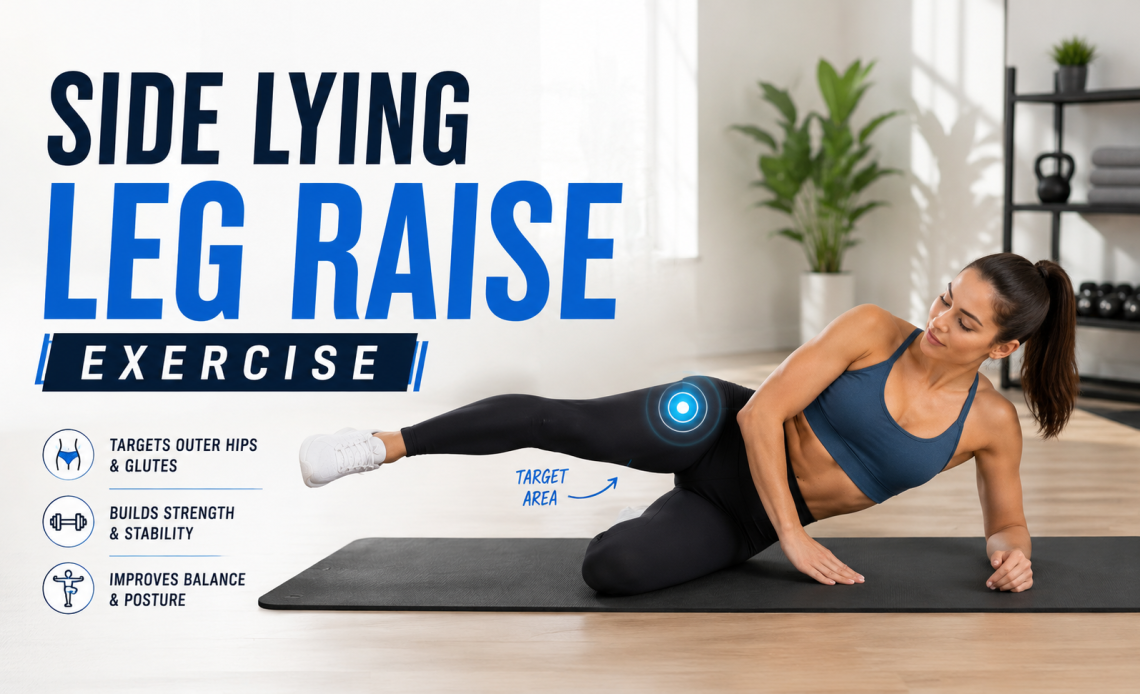
The side lying leg raise exercise is performed lying on your side with your body in a straight line, raising the top leg to about 45 degrees and lowering it with control without letting it rest on the bottom leg between reps. It directly targets the gluteus medius and hip abductors, muscles that stabilize the pelvis during walking, running, and all single-leg movements. Keep your hips stacked, your core braced, and your toes pointing slightly downward throughout every rep for maximum activation.
Why This Exercise Belongs in Your Routine
Most people train what they can see. Quads, hamstrings, glutes. The gluteus medius, which sits on the outer hip and controls side-to-side pelvic stability, gets skipped almost universally. The result shows up as knee cave during squats, hip drop during running, and lower back pain that seems to appear out of nowhere during longer training sessions.
The side lying leg raise exercise fixes that gap directly. It isolates the gluteus medius and hip abductor group with no equipment, no gym required, and no complexity. Physical therapists use it in virtually every lower limb rehabilitation program. Strength coaches use it as a warm-up activation drill before heavy compound work. Runners use it to address the single most common biomechanical weakness that leads to IT band syndrome and patellofemoral pain.
If you have been doing it and not feeling it in the right place, or you want to do it properly from the start, this guide covers everything: exact form, muscles targeted, common errors, variations, and how to fit it into a training week.
Exercise at a Glance
| Detail | Information |
| Primary muscle | Gluteus medius |
| Secondary muscles | Gluteus minimus, tensor fasciae latae (TFL), hip abductors |
| Equipment needed | None (mat optional; ankle weights for progression) |
| Difficulty | Beginner to intermediate |
| Best used for | Hip stability, glute activation, rehab, warm-up, injury prevention |
| Common in | Physical therapy, pilates, running programs, strength warm-ups |
| Sets and reps | 2 to 3 sets of 12 to 20 reps per side |
Muscles Worked in the Side Lying Leg Raise
Understanding which muscles the exercise targets tells you exactly how to position your body to make it work properly.
Gluteus Medius: The Primary Target
The gluteus medius is a fan-shaped muscle on the outer surface of the pelvis. Its job is hip abduction (lifting the leg away from the body’s midline) and pelvic stabilization during single-leg loading. When you walk and your right foot hits the ground, your right gluteus medius fires to prevent your left hip from dropping. Weakness here is one of the leading contributors to a wide range of lower limb injuries.
Supporting Muscles
The gluteus minimus sits beneath the gluteus medius and assists with abduction and internal rotation. The tensor fasciae latae (TFL) runs along the outer thigh and also contributes to hip abduction, though overreliance on it is a sign the exercise is being performed with the leg rotated in the wrong direction. The obliques and transverse abdominis work isometrically throughout to keep the trunk stable on the floor.
If you feel the side lying leg raise mainly in your outer thigh rather than your outer hip, your toes are likely pointing upward. Rotating the leg so the toes point slightly toward the floor shifts activation from the TFL to the gluteus medius where it belongs.
Step-by-Step Form Guide
Work through these in order. Each step builds on the last and the most common errors all trace back to skipping one of the early setup points.
- Lie on your side on a mat with your body in a straight line from head to heel. Stack your hips directly on top of each other. Your bottom arm can extend under your head for support, or you can rest your head on your hand with your elbow bent.
- Place your top hand flat on the floor in front of your chest. This helps prevent your trunk from rolling forward or backward as the leg moves.
- Engage your core by drawing your navel in gently. Your lower back should maintain its natural curve, not flatten completely into the mat or arch excessively away from it.
- Point your top foot so the toes angle slightly toward the floor. This is the internal rotation cue that shifts activation into the gluteus medius and away from the TFL.
- Keeping your leg straight, raise it to approximately 45 degrees from the floor. Do not go higher. Above 45 degrees the pelvis begins to tilt and the lower back takes over from the hip abductors.
- Hold at the top for one second. Actively squeeze the outer hip at the top of the range. This brief isometric contraction meaningfully increases muscle activation compared to simply swinging the leg up and down.
- Lower the leg slowly, taking 2 seconds on the descent. Stop just before the foot touches or rests on the bottom leg. Keep the tension in the hip abductors throughout.
- Complete all reps on one side before switching. Rolling over and starting the other side immediately keeps set rest symmetrical and makes it easier to compare how each side feels.
Form Mistakes That Reduce Results
- Rolling the hips forward or backward. The most common setup error. If your top hip drifts forward as the leg raises, you are no longer working in pure abduction. Keep both hip bones stacked vertically throughout every rep. The top hand on the floor in front of you is your anchor.
- Raising the leg too high. It looks more impressive to lift higher, but anything above 45 degrees introduces hip flexor compensation and lumbar rotation. The gluteus medius reaches peak activation between 30 and 45 degrees. Stay in that range.
- Toes pointing up or to the ceiling. This is the single most common activation error. Toes pointing up externally rotates the hip and shifts the workload to the TFL and hip flexors. Toes slightly down internally rotates the hip and loads the gluteus medius correctly.
- Using momentum to swing the leg. A slow, controlled tempo creates the tension that builds muscle and stability. Swinging makes the exercise easier and removes the eccentric phase where much of the training benefit occurs.
- Letting the waist sag into the floor. If your obliques switch off during the set, the side of your trunk collapses and the movement becomes compensatory rather than targeted. Maintain a small gap between your bottom waist and the floor throughout.
Variations and Progressions for Every Level
| Variation | Best For | How It Differs |
| Standard side lying leg raise | Beginners, rehab, warm-up activation | Baseline movement as described above |
| Ankle weight variation | Intermediate progression | Add 1 to 3 kg ankle weight; increases load without changing mechanics |
| Resistance band variation | Intermediate to advanced | Band around thighs just above knees; increases resistance through full range |
| Pulsing variation | Muscle endurance, burn sets | Small pulses at top of range for 10 to 20 reps after standard reps |
| Side lying clam shell | Hip external rotation, beginners | Knees bent, feet together; top knee raises like a clamshell opening |
| Side plank with leg raise | Advanced; full lateral chain | Perform from a side plank position; combines stability and abduction |
The progression order that works best for most people: master the standard version for 3 sets of 15 reps with full control, then add a 1 kg ankle weight, then move to a resistance band. The pulsing variation works well as a burnout added to the end of the final set once the primary reps are complete.
How to Add Side Lying Leg Raises to Your Training
Where you place this exercise in a session determines what you get from it:
- As a warm-up activation drill: 2 sets of 15 reps per side before squats, deadlifts, lunges, or any lower body session. This pre-activates the gluteus medius so it fires correctly during compound movements. Athletes who skip glute activation often find their knees cave inward during heavy squats regardless of how much they think about it. Warming the muscle up first solves the problem mechanically rather than relying on cueing.
- As a standalone rehab or corrective exercise: 3 sets of 12 to 20 reps per side, two to three times per week. This is the typical physical therapy prescription for hip abductor weakness, IT band syndrome, patellofemoral pain, and post-surgical hip rehabilitation.
- As an accessory exercise within a strength session: 3 sets of 15 reps per side placed at the end of a lower body day. By this point the primary muscles are fatigued and the isolation work ensures the smaller stabilizers get a direct training stimulus rather than hiding behind the larger movers.
- As part of a pilates or yoga-adjacent floor circuit: combine with glute bridges, clamshells, and donkey kicks for a complete hip and glute floor sequence. This combination is especially effective for people who cannot yet load the lower body with weights due to injury or deconditioning.
What Results to Expect and When
The side lying leg raise is a corrective and foundational exercise rather than a primary hypertrophy driver. The results it produces are real but show up differently from a heavy compound movement:
- Weeks 1 to 2: Improved mind-muscle connection with the outer hip. Many people feel the gluteus medius working during daily activities like climbing stairs and walking for the first time, simply because the muscle has been woken up through direct training.
- Weeks 3 to 6: Measurable improvement in pelvic stability during single-leg movements. Knee cave during squats typically reduces. Hip drop during running decreases. These are functional outcomes that protect joints rather than change appearance.
- Weeks 6 to 12: Visible improvement in outer hip shape and fullness if combined with sufficient overall training volume and nutrition. The gluteus medius contributes to the rounded, three-dimensional look of the glute complex. It cannot be fully developed with compound exercises alone.
A 2019 study in the Journal of Sport Rehabilitation measured gluteus medius activation across 11 common exercises using EMG. The side lying leg raise produced the second highest gluteus medius activation of all exercises tested, behind only the single-leg squat, and significantly higher activation than the squat, lunge, and hip bridge. For a bodyweight floor exercise requiring no equipment, that is a remarkable output.
The Detail Most Guides Skip
Almost every guide on side lying leg raises focuses on the concentric phase, the lifting. The eccentric phase, the 2-second controlled lowering, is where the majority of the structural adaptation occurs. Eccentric loading is what creates the microscopic muscle damage that drives hypertrophy and the neuromuscular adaptations that improve stability. Dropping the leg between reps throws away half the training stimulus.
There is also a timing element that is consistently overlooked. The one-second isometric hold at the top of each rep is not optional padding. Research on gluteus medius training consistently shows that peak muscle activation occurs during the isometric contraction at end range, not during the dynamic lift. Removing the hold reduces the effectiveness of the exercise by a measurable margin even if every other technical point is correct.
Slow down, pause at the top, control the descent. Those three adjustments alone will make a set of 15 reps feel more demanding than a set of 25 done with momentum, and they will produce significantly better results over time.