
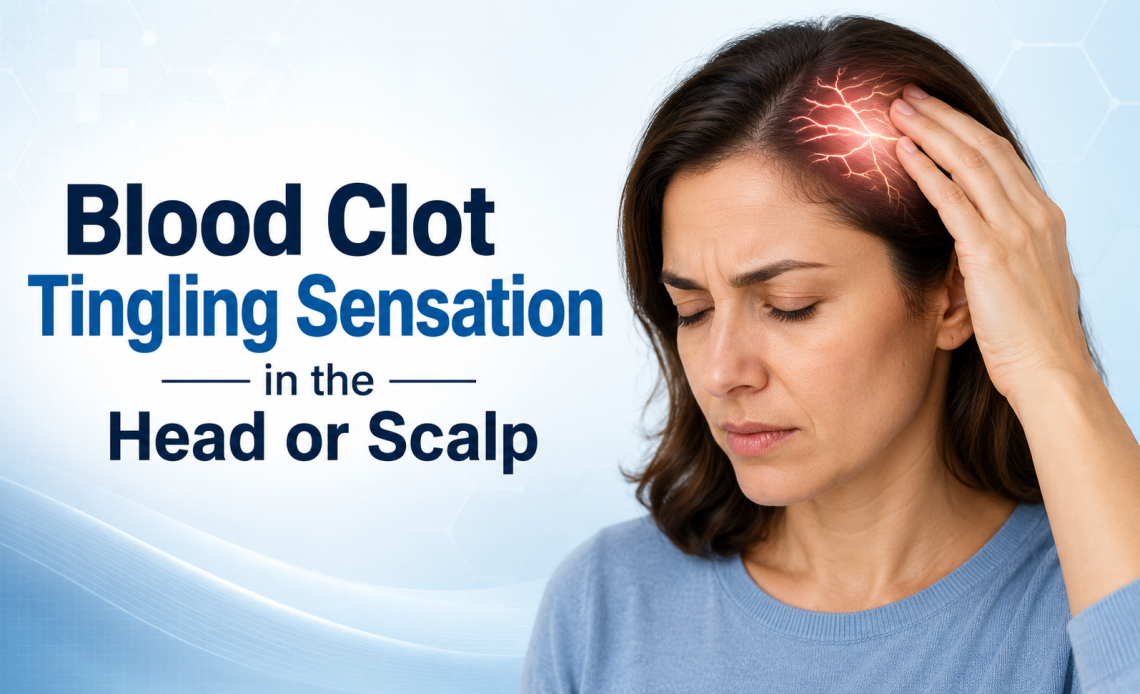
CALL 911 NOW if tingling in the head or scalp is accompanied by any of these: sudden facial drooping on one side, arm weakness or numbness, slurred or lost speech, sudden vision changes, the worst headache of your life, or sudden confusion. Do not drive yourself. These are stroke warning signs.
Quick Answer
A blood clot tingling sensation in the head or scalp on its own is rarely a sign of a blood clot. Scalp tingling has many common, benign causes including tension headaches, nerve compression, anxiety, and vitamin deficiency. Blood clots in the brain, the type that cause strokes, typically produce sudden, unmistakable neurological symptoms: facial drooping, arm weakness, speech difficulty, vision loss, or a sudden severe headache. Tingling that appears alongside any of those symptoms is a medical emergency. Tingling alone, without other neurological signs, almost always has a non-dangerous explanation.
At a Glance
| Question | Short Answer |
| Can a blood clot cause scalp tingling? | Rarely, and almost never as the only symptom |
| What usually causes scalp tingling? | Tension headache, nerve compression, anxiety, vitamin deficiency, tight hairstyles, migraines |
| What are actual blood clot symptoms in the head? | Sudden severe headache, facial droop, arm weakness, speech problems, vision changes, confusion |
| When is tingling a medical emergency? | When it accompanies facial droop, one-sided weakness, speech difficulty, or sudden vision loss |
| Which side is more concerning? | Tingling on only one side of the face or head is more neurologically significant than general scalp tingling |
| What is the FAST acronym? | Face, Arms, Speech, Time — the four stroke warning signs to act on immediately |
You Felt Something Strange in Your Head and You Searched to Find Out If It Is Serious
That is an entirely reasonable response. Tingling in the head or scalp is unsettling, especially when it seems to come from nowhere.
The most important thing to know upfront is this: scalp tingling on its own, with nothing else accompanying it, is almost never a blood clot. The sensations people describe from blood clots in the brain are sudden, severe, and typically involve multiple body systems at once. A quiet tingle across the top of the head that has been there for a few minutes, while you feel otherwise normal, is a very different presentation.
Here is the full picture, including exactly what combination of symptoms should override that reassurance and send you straight to emergency care.
Can a Blood Clot in the Head Actually Cause Scalp Tingling?
It is possible but uncommon. A cerebral blood clot, also called a cerebral thrombus, disrupts blood flow to areas of the brain. When that disruption affects sensory-processing regions or the nerve pathways connected to the face and scalp, tingling or numbness in the head can result.
However, neurologists consistently point out that scalp tingling as an isolated symptom is not a classic presentation of a brain blood clot or stroke. The more typical picture involves sudden, severe onset of multiple neurological symptoms together, not a gradually noticed tingle in one part of the scalp.
The one pattern that is more concerning than general scalp tingling is tingling or numbness that is clearly one-sided, specifically affecting one side of the face. That lateralized pattern has more neurological significance than diffuse or bilateral scalp sensations, and is listed alongside classic stroke symptoms by neuroscience specialists.
What Are the Actual Warning Signs of a Blood Clot in the Head?
Recognizing these is the most practically important thing in this article. The classic blood clot or stroke presentation is sudden and involves the brain losing access to blood and oxygen rapidly. Symptoms that appear suddenly and worsen quickly are the critical pattern:
| Warning Sign | What It Looks Like | Urgency |
| Sudden severe headache | Described as the worst headache of your life, appears instantly, no prior trigger | Call 911 immediately |
| Facial drooping | One side of the face droops or goes numb, smile looks uneven | Call 911 immediately |
| Arm or leg weakness | One arm drifts down when both are raised, sudden weakness in one limb | Call 911 immediately |
| Speech difficulty | Slurred words, inability to speak, or not understanding what others say | Call 911 immediately |
| Vision changes | Blurring, double vision, or sudden loss of vision in one or both eyes | Call 911 immediately |
| Confusion or disorientation | Sudden confusion about location, time, or what is happening | Call 911 immediately |
| Loss of coordination | Sudden trouble walking, stumbling, or loss of balance | Call 911 immediately |
| One-sided face or head numbness | Tingling or numbness clearly isolated to one side of the face, especially alongside any of the above | Call 911 immediately |
What Is the FAST Method and Why Does It Matter for Blood Clots?
FAST is the stroke warning sign acronym used by emergency medicine and public health organizations including the CDC and the American Stroke Association. It stands for:
- F, Face drooping: ask the person to smile. Does one side of the face droop or look uneven?
- A, Arm weakness: ask the person to raise both arms. Does one arm drift down or feel weaker?
- S, Speech difficulty: ask the person to repeat a simple phrase. Is the speech slurred, strange, or absent?
- T, Time to call 911: if any one of those three signs is present, call 911 immediately. Time between symptom onset and treatment directly determines how much brain tissue can be saved.
The CDC recommends getting to the hospital within three hours of the first stroke symptoms for clot-busting medications to be most effective. Every minute of delay matters.
What Causes Are More Likely Behind Scalp Tingling Than a Blood Clot?
For the vast majority of people who notice scalp tingling without other neurological symptoms, one of the following far more common causes is responsible:
| Likely Cause | Why It Causes Tingling | What Helps |
| Tension headache | Tight scalp muscles compress nerves that run along the scalp surface | OTC pain relief, rest, stress reduction |
| Anxiety or stress | The nervous system’s fight-or-flight response can produce tingling sensations across the scalp | Deep breathing, managing the underlying anxiety |
| Nerve compression from posture | Sleeping in a position that puts pressure on nerves in the neck or upper back | Changing sleep position, stretching |
| Vitamin B12 deficiency | B12 is essential for nerve health; deficiency causes numbness and tingling in multiple areas | Blood test, B12 supplementation if deficient |
| Migraine aura | Neurological changes before or during a migraine can cause tingling or crawling sensations on the scalp | Migraine management plan with a neurologist |
| Scalp conditions (psoriasis, eczema) | Inflammation of the scalp skin can produce tingling, burning, or prickling sensations | Dermatological treatment |
| Tight hairstyle or headwear | Pressure on the scalp surface over time irritates the nerves that run beneath it | Loosening the style or removing the source of pressure |
| Occipital neuralgia | Inflammation of the nerves at the base of the skull that run up over the scalp | Doctor evaluation, nerve block injections if persistent |
How Do You Tell the Difference Between Harmless Scalp Tingling and Something Serious?
Two characteristics of the tingling itself do most of the sorting:
Speed of onset: tingling that came on gradually, has been present for hours or days, or fluctuates with stress and posture is far more likely to be benign. Tingling that appeared suddenly and intensely, especially alongside anything else unusual, is the kind to take seriously.
What else is happening: isolated scalp tingling with no other symptoms, where you otherwise feel completely normal, is the least concerning pattern. Tingling that comes with any neurological sign from the table above moves it immediately into the emergency category.
A simple self-check takes about thirty seconds: raise both arms and hold them level, say a sentence out loud, smile in a mirror. If anything looks or feels wrong in any of those, call 911 rather than waiting to see if the sensation passes.
Is One-Sided Tingling in the Head More Serious Than General Scalp Tingling?
Yes, in most cases. Brain blood clots affect one hemisphere of the brain and produce symptoms on the opposite side of the body, or on the same side of the face in some cases, depending on which blood vessels are involved.
Neurological tingling from a stroke or TIA (transient ischemic attack, sometimes called a mini-stroke) typically follows this pattern of one-sided involvement rather than general whole-scalp sensations. If you are experiencing tingling that is clearly limited to one side of your face or head and you cannot identify an obvious cause such as sleeping on that side or a tension headache, it is worth getting a medical evaluation promptly rather than monitoring it at home.
What Is a TIA and Is It Less Serious Than a Full Stroke?
A transient ischemic attack, known as a TIA or mini-stroke, occurs when blood flow to part of the brain is temporarily blocked and then restores. Symptoms resemble a stroke but resolve within minutes to a few hours.
The critical point about a TIA is that it is not less serious than a stroke. It is a warning that a major stroke may follow, sometimes within days. Research cited by the American Stroke Association shows that up to 15 percent of strokes are preceded by a TIA, and the risk of a subsequent stroke is highest in the first 48 to 72 hours after a TIA.
If symptoms that look like stroke signs resolve on their own, this is not reassurance. It is a reason to seek emergency evaluation immediately rather than waiting. Capital Health Medical Center in Pennington, New Jersey holds a Comprehensive Stroke Center designation, the highest level of certified stroke care, meaning patients experiencing stroke or TIA symptoms in the Mercer County area have access to the full spectrum of acute stroke treatment on-site.
What Happens During Emergency Evaluation for a Possible Blood Clot in the Head?
If you arrive at an emergency department with stroke symptoms or a suspected head blood clot, the evaluation typically follows a rapid sequence designed around the time-sensitivity of stroke treatment:
- Immediate neurological assessment: a brief but systematic evaluation of speech, coordination, strength, and reflexes to identify stroke signs.
- CT scan of the brain: quickly identifies whether a bleed is occurring inside the skull and rules out hemorrhagic stroke before any clot-busting medication is given.
- MRI if needed: provides a more detailed picture of blood flow and identifies areas of brain tissue that may be at risk.
- Blood tests: including clotting factors, blood count, and metabolic panel to identify contributing conditions.
- Treatment decision: if an ischemic stroke is confirmed within the treatment window, clot-dissolving medication such as tPA may be given. Mechanical thrombectomy to physically remove the clot is also available at comprehensive stroke centers within a defined time window.
The availability of both medication and procedural treatment for acute stroke depends on reaching a hospital with sufficient specialist resources quickly. For patients in New Jersey’s Mercer County region, access to stroke care and neurosciences at a Comprehensive Stroke Center means the full range of these interventions is available without needing transfer to another facility.
When Should You See a Doctor About Scalp Tingling Even If It Is Not an Emergency?
- Tingling that has persisted for more than a few days without an obvious cause
- Tingling that comes and goes but has been happening repeatedly over several weeks
- Any tingling accompanied by a pattern of increasing headaches
- Tingling in conjunction with neck pain or stiffness
- If you have known risk factors for blood clots, including atrial fibrillation, recent surgery, cancer, prolonged immobility, or a history of clotting disorders
- If you are on blood thinners and notice new or unusual neurological sensations
A neurologist is the right specialist for persistent or unexplained head and scalp tingling. A general practitioner can handle the initial evaluation and order relevant blood tests including B12, thyroid function, and inflammatory markers.
What Risk Factors Increase the Chance of a Blood Clot in the Head?
| Risk Factor | Why It Increases Clot Risk |
| Atrial fibrillation (AFib) | Irregular heartbeat allows blood to pool in the heart and form clots that can travel to the brain |
| High blood pressure | Chronic high BP damages blood vessel walls and increases the risk of clot formation and rupture |
| Diabetes | Damages blood vessels and increases systemic inflammation that contributes to clotting |
| High cholesterol | Contributes to arterial plaque buildup that can rupture and trigger a clot |
| Smoking | Damages vessel walls and increases the tendency of blood to clot |
| Family history of stroke or clotting disorders | Genetic factors affect clotting proteins and vessel health |
| Recent surgery or prolonged immobility | Slows blood circulation and increases clot formation risk |
| Use of certain medications (estrogen-containing contraceptives) | Increases clotting tendency in some individuals |
What Most People Get Wrong About Head Tingling and Blood Clots
The most common misunderstanding goes in both directions. Some people dismiss serious stroke symptoms as “just a tingle” because the sensation itself feels mild. Others catastrophize genuinely benign scalp sensations into a health emergency that does not exist.
The clinical key, confirmed across multiple neurology sources, is that blood clots in the brain produce sudden-onset, rapidly worsening symptoms that affect multiple neurological functions at once. A tingle that has been gradually building, stays in the same spot, and has not changed your ability to speak, see, or move your face and limbs is almost certainly not a blood clot.
That said, “almost certainly” is not “definitely.” Anyone with known stroke risk factors who is experiencing new and unexplained head sensations deserves a prompt medical evaluation, not reassurance from an online article including this one.
The Two Column Test for Scalp Tingling
Before deciding what to do, mentally place your symptoms in one of two columns:
| Act Now, Call 911 | Monitor and See a Doctor Soon |
| Sudden onset, appeared in seconds or minutes | Gradual onset, built over hours or days |
| Worst headache of your life | Dull or familiar type of headache |
| One-sided facial drooping or numbness | Bilateral or general scalp sensation |
| Arm weakness or drift | No weakness, normal strength |
| Speech slurred, absent, or confused | Speech completely normal |
| Vision changes in either eye | Vision completely normal |
| Nausea, vomiting, confusion together | No accompanying neurological symptoms |
If even one item from the left column applies, that column overrides everything on the right. Call 911 and do not drive yourself.
What Should You Do Right Now?
If you are currently experiencing scalp tingling alongside any FAST signs (face, arm, speech, time) or a sudden severe headache, stop reading and call 911.
If your tingling is isolated, has been present for a while, and you otherwise feel completely normal, the likelihood of a blood clot is low. Book a GP appointment to investigate causes such as vitamin deficiency, nerve compression, or occipital neuralgia.
Avoid dismissing symptoms that include any sudden neurological change simply because they feel mild in the moment. Strokes can begin with subtle sensations that escalate rapidly, and the treatment window for the most effective interventions is measured in hours, not days.